
June 3, 2026 - PBS News Hour full episode
6/3/2026 | 57m 46sVideo has Closed Captions
June 3, 2026 - PBS News Hour full episode
June 3, 2026 - PBS News Hour full episode
Problems playing video? | Closed Captioning Feedback
Problems playing video? | Closed Captioning Feedback
Major corporate funding for the PBS News Hour is provided by BDO, BNSF, Consumer Cellular, American Cruise Lines, and Raymond James. Funding for the PBS NewsHour Weekend is provided by...
June 3, 2026 - PBS News Hour full episode
6/3/2026 | 57m 46sVideo has Closed Captions
June 3, 2026 - PBS News Hour full episode
Problems playing video? | Closed Captioning Feedback
Where to Watch PBS News Hour
PBS News Hour is available to stream on pbs.org and the PBS app.
Providing Support for PBS.org
Learn Moreabout PBS online sponsorshipGEOFF BENNETT: Good evening.
I'm Geoff Bennett.
AMNA NAWAZ: And I'm Amna Nawaz.
On the "NewsHour" tonight: Iranian strikes set Kuwait's largest airport ablaze, yet another test of the fragile cease-fire with the United States.
GEOFF BENNETT: Who's leading the race to be California's next governor?
We delve into the latest results and other takeaways from yesterday's primary elections across the country.
AMNA NAWAZ: And the storied news magazine "60 Minutes" in turmoil after its longtime correspondent Scott Pelley is fired by new leadership.
STEVE KROFT, Former "60 Minutes" Correspondent: I think that this is journalistic interference.
It makes no business sense whatsoever.
(BREAK) AMNA NAWAZ: Welcome to the "News Hour."
Tonight, the U.S.
says its cease-fire with Iran is still holding, but it was a violent day, with the U.S.
and Iranian militaries trading fire overnight.
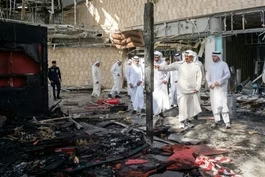
And, today, Iran struck Kuwait's main airport, killing one person and injuring dozens more.
GEOFF BENNETT: The cease-fire is also being tested by the ongoing conflict in Lebanon, which has exposed rare public tensions between President Trump and Israel's prime minister.
Nick Schifrin begins his report with the new violence in the Gulf.
NICK SCHIFRIN: Inside Kuwait's international airport today, this is what cease-fire looks like, part of the passenger terminal clouded by dust and debris and the crackle of fire.
An airport employee points to the spot where he says Iranian drones made a direct hit.
The attack temporarily shut down the airport and shook America's Gulf allies, who are advocating for a U.S.-Iran diplomatic deal.
But there is no deal and the attacks are increasing.
Today, Iran fired missiles at Kuwait and for the first time since the cease-fire began Bahrain and the headquarters of the U.S.
Navy's Fifth Fleet.
The missiles either failed or were shot down, but the cease-fire is being strained.
Iran calls these launches a response to the U.S.
striking this oil tanker's engine to enforce the U.S.
blockade of Iranian ports.
DONALD TRUMP, President of the United States: They were slightly provoked, because we took a strong action for a different reason.
So they were reciprocating, yes.
NICK SCHIFRIN: Today, in the Oval Office, President Trump also labeled Iran strikes a response to U.S.
attacks, even though the U.S.
military called its strike self-defense after Iranian attacks.
And, today, as he has repeatedly in the past, President Trump dangled the promise of a diplomatic deal.
DONALD TRUMP: If it happens.
It might not happen.
Who knows.
But if it happens, it could happen like over the weekend.
NICK SCHIFRIN: But just hours before, on The New York Post podcast "Pod Force One" President Trump did not deny a much longer timeline.
MIRANDA DEVINE, "Pod Force One": So you think the blockade is still being placed by Labor Day?
DONALD TRUMP: I don't know.
I mean, I think it could be, but I think it's unlikely.
NICK SCHIFRIN: And President Trump confirmed he recently got salty with Israeli Prime Minister Benjamin Netanyahu.
MIRANDA DEVINE: Axios reported that you had a phone call with Bibi Netanyahu, the prime minister of Israel, in which you were angry with him.
You said, are you effing crazy?
What are you effing doing?
I helped you stay out of jail.
Is that true?
Did you speak to him in those terms?
DONALD TRUMP: I did.
I wouldn't say angry.
I was a little bit perturbed at his constantly fighting with Lebanon.
You know, at some point, I said: "Bibi, we have got to stop this."
BENJAMIN NETANYAHU, Israeli Prime Minister: If you think this is a crisis, you should be in some other conversations.
NICK SCHIFRIN: In a CNBC interview today, Netanyahu downplayed their differences.
And Israeli officials note to "PBS News Hour" this was not the first time that Trump cursed at Netanyahu.
BENJAMIN NETANYAHU: Sometimes, we have -- as in the best of families, you have these tactical disagreements.
We always find a way to work them out.
And we do so as great friends.
We can disagree in the morning and by the afternoon we have common action.
NICK SCHIFRIN: But Israel insists it will continue its unilateral campaign in Lebanon, striking the south today.
Israeli soldiers have invaded and occupied Southern Lebanon deeper inside the country than at any point in a quarter-century.
And, today, Netanyahu warned he would keep pushing President Trump to allow targeted strikes in the capital, Beirut.
BENJAMIN NETANYAHU: Terrorist chieftains, many of them are in Beirut.
So they're giving orders to target our cities from Beirut.
And we said, if you keep on targeting Israeli territory and our cities and our communities, then we will take out these terror chieftains in Beirut with surgical strikes.
REP.
JOAQUIN CASTRO (D-TX): My question is, do you agree that Israel should stop its military campaign in Lebanon and support the president's negotiations for a peace agreement with Iran?
NICK SCHIFRIN: On Capitol Hill today, lawmakers questioned Secretary of State Marco Rubio whether Lebanon jeopardized an Iran deal.
Rubio put the blame on Iranian proxy Hezbollah, not Israel.
MARCO RUBIO, U.S.
Secretary of State: What they're increasingly doing is taking more territory in the south to deny them launching space, because, understand, these rockets are being launched into northern villages and cities in Israel.
NICK SCHIFRIN: And President Trump today said he wanted Iran to make a deal independent of the war in Lebanon.
DONALD TRUMP: I'd like to separate it.
I'd like to have a separate thing, because it is separate.
NICK SCHIFRIN: But Iranian officials tell "PBS News Hour" they insist any initial memorandum of understanding include a Lebanon cease-fire.
And so the stalemate continues, both in the talks and in the Strait of Hormuz, where a fifth of the world's oil flowed before the war.
For the "PBS News Hour," I'm Nick Schifrin.
AMNA NAWAZ: And, late today, the U.S.
House approved a war powers resolution that would stop further military action in Iran, in a significant rebuke of President Trump's handling of the war.
Four Republicans defied Trump and supported the measure, which would still need to pass in the Senate before heading to the president's desk for an almost certain veto.
GEOFF BENNETT: Well, half-a-dozen states held their primary elections yesterday, giving a clearer picture of how some of the nation's high-profile midterm races will shape up this fall.
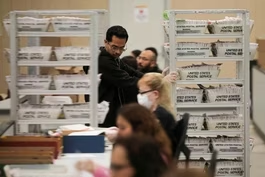
In California, ballots are still being counted in several key races, chief among them the race for governor.
Three candidates are locked in a fight for the top two spots that will advance to November's run-off, on the Democratic side, former Health and Human Services Secretary Xavier Becerra and billionaire activist Tom Steyer and Republican media commentator Steve Hilton.
XAVIER BECERRA (D), California Gubernatorial Candidate: It appears that we are on track to advance to November.
TOM STEYER (D), California Gubernatorial Candidate: We're going to wait until every ballot is counted.
We're going to give democracy time to work, and we know we finished really strong.
STEVE HILTON (R), California Gubernatorial Candidate: Change is coming to California and it's long overdue.
GEOFF BENNETT: Meantime, in Iowa, the matchups for both Senate and governor are now set.
In the Senate race for Republican Congresswoman Ashley Hinson will face Democratic challenger and former Paralympian Josh Turek to replace retiring Senator Joni Ernst.
And in the race for governor, businessman Zach Lahn narrowly edged out Trump-backed Congressman Randy Feenstra.
He will face Democratic state auditor Rob Sand in what's set to be one of the nation's most watched gubernatorial races this fall.
For more on what these primary results mean heading into the fall, we are joined now by Nathan Gonzales, editor and publisher of Inside Elections.
Always good to see you.
GEOFF BENNETT: So let's start in California, shall we?
The governor's race is still being sorted out.
These mail-in votes are still being counted.
But it appears that the Democrat Xavier Becerra is going to face Republican Steve Hilton this fall.
In this crowded Democratic field, how did Xavier Becerra edge out the rest?
NATHAN GONZALES: Well, I think that he ended up being the safe pick.
I mean, remember that we have gone through many chapters with this race and there was a chapter where it looked like Democrats were going to get locked out of the general election because of California's top two system and the dozens of Democratic candidates.
There was a chance that two Republicans were going to finish.
So that potential for catastrophe, along with Congressman Eric Swalwell's implosion and exit from the race, then caused some Democrats to say there needs to be some consolidation.
Becerra looked like a safe pick.
And it looks like, at a minimum, we know Democrats avoided that catastrophic outcome.
We will see.
And, by the end, because there are still so many votes to be counted, Becerra could finish ahead -- finish ahead moving into November after these primary ballots are counted.
GEOFF BENNETT: And California is among the states that did the mid-decade redistricting, redrew their congressional maps.
Which races are you watching most closely?
NATHAN GONZALES: One of them is California's Sixth District in the Sacramento area.
This was a district Democrats drew to elect a Democrat.
But, right now, the top two contenders are Republican, now independent Congressman Kevin Kiley and a Republican candidate, Michael Stansfield.
If that continues, that means that you're going to have a Republican and a former Republican in the general election and no Democrat.
But with the remaining ballots that are coming in, I would expect Richard Pan, the Democratic candidate, who's narrowly in third to inch into one of those top two spots and Democrats will have a chance to get a district that they have drawn for themselves.
We're also watching the 22nd District, which is in the Central Valley.
Congressman David Valadao, the Republican is moving on.
It looks like Democrat Randy Villegas is going to be challenger.
And Valadao has this reputation for always winning tough races, but he lost in President Trump's first midterm.
He's at risk in this second, Trump's second midterm and it's a race to watch.
GEOFF BENNETT: Let's shift our focus to Alabama, shall we?
Because the Supreme Court allowed Alabama to move forward with the congressional map that eliminates one of the state's two majority-Black districts, as you well know.
So coming on the heels of other voting rights and redistricting battles, what does this ruling mean for Democrats' hopes of winning back the House?
NATHAN GONZALES: I mean, it makes it one seat more challenging.
It looks like Democrats will lose a seat in Alabama.
And when you look at redistricting nationwide with the cases and the maps, it looks like Republicans will net more seats as a result of it.
But it's not going to be enough to shield them from the potential midterm backlash when the president's job approval rating is barely at 40 percent or the backlash against the party in power at a time when the country is heading the wrong direction.
GEOFF BENNETT: And in Iowa, Democrats are bullish about their chances in the Senate race there.
What informs that optimism?
NATHAN GONZALES: Well, Iowa is a good example of Republican states that normally we would not be talking about, but because the president is in such a weak political position, the economy is in a weak position, we're talking about Iowa, Ohio, Alaska, Texas, South Carolina.
And Iowa is a state that Democrats need to win at least two Republican states in the Senate to get to the majority.
They might need to win three if they can't win Maine, but it's a possibility because of the overall political environment that we're seeing.
GEOFF BENNETT: You mentioned Maine.
Give us a sense of what's happening there and what it means for the upcoming vote.
NATHAN GONZALES: Well, Graham Platner, the likely Democratic nominee, the primary next week, is undergoing, is facing all sorts of problems with how many women who is not his wife is he texting, is his chest tattoo a Nazi symbol or not, and -- but yet he was politically strong enough to push the sitting governor out of the primary.
And so Democrats now are wrestling with, this is a must-win seat for the majority, because it's Republican Susan Collins in a Democratic state, but he is facing all sorts of things.
And it's not just things that happened in the distant past.
The tattoo can kind of be -- said, well, that was when he was younger.
This other thing with texting other women, that's something that happened fairly recently.
And so we will see what else comes out.
And all that to say, he is a Democrat in a Democratic state in a good Democratic cycle.
He still has a chance to win.
GEOFF BENNETT: And there are lots of people who aren't giving him a pass for that tattoo at all, whether he was younger or not.
GEOFF BENNETT: But let's talk about California, because, even as we say most people are focused on that governor's race, maybe.
I think a lot of people are focused on the mayor's race in Los Angeles with Karen Bass and Spencer Pratt.
GEOFF BENNETT: There's another candidate there.
Again, votes are still being counted, but what's the latest?
NATHAN GONZALES: Well, I mean, I expect Mayor Bass to end up winning reelection.
It's been quite a saga.
I think that Spencer Pratt's emergence onto the scene is an example of voters view politicians with such disdain and are so upset with the current status quo that they're willing to give any non-politician a second look, a third look.
And I think that helped him kind of get into this conversation.
But, fundamentally, L.A.
is still a Democratic city.
And I expect a Democrat to win that race.
GEOFF BENNETT: Nathan Gonzales, thanks again.
That's a lot to run through, lots of states, lots of cities.
NATHAN GONZALES: On little sleep, but we will make it -- we made it happen.
GEOFF BENNETT: Indeed.
Good to see you, friend.
NATHAN GONZALES: Good to see you.
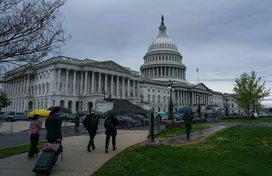
AMNA NAWAZ: Well, primary voters in New Jersey last night also finalized the race for one of the nation's most competitive seats and one of the most unusual, because the incumbent Republican, Congressman Tom Kean Jr., hasn't been seen on the campaign trail or Capitol Hill for months.
As congressional correspondent Lisa Desjardins reports, his absence raises broader questions.
LISA DESJARDINS: Whoever else has come by congressman Tom Kean's Capitol Hill office, for the past three months, he was not one of them.
What do we know about where he is or not?
BENJAMIN HULAC, NJ Spotlight News: We really don't know anything.
LISA DESJARDINS: Benjamin Hulac is the Washington correspondent for NJ Spotlight.
Tell us the status of Congressman Kean right now.
BENJAMIN HULAC: Wish I could.
I'm not trying to be oblique, but he last voted in the House on March 5 and has not been seen in public since.
And the only thing I have gotten out of his office is that he has a personal medical issue.
LISA DESJARDINS: This was Kean's last known day in Washington.
He appeared at a committee hearing.
REP.
TOM KEAN (R-NJ): I agree with my colleagues to support this legislation.
LISA DESJARDINS: Kean waited until late April to issue a cryptic statement, writing that "A doctor forecast full recovery very soon."
I asked House Speaker Mike Johnson about this today.
REP.
MIKE JOHNSON (R-LA): As soon as he's ready to talk about that, you're all going to breathe a sigh of relief and say that makes sense.
What he's dealing with is something very common and not a big thing.
LISA DESJARDINS: Kean has been the longest, but not the only absence this year.
Democrat Frederica Wilson, who's retiring, has missed a month of votes, eventually saying she had eye surgery.
Republican Julia Letlow missed two weeks of votes as she campaigned for U.S.
Senate.
MAN: The yeas are 212.
The nays are 212.
The concurrent resolution is not adopted.
LISA DESJARDINS: This all led to a tie, a near-win for Democrats on a statement vote last month to end the war in Iran.
So far this year, the House has been in session 76 days.
Congressman Kean has missed more than half of that.
But many days, a dozen or more are absent in a one-or-two-vote-margin Congress.
REP.
CHUCK FLEISCHMANN (R-TN): As the legislation becomes more important, in my case, for appropriation bills, every vote counts.
REP.
MARK ALFORD (R-MO): I represent 772,047 individuals, Republicans, Democrats, independents, and they expect me to show up to my job.
REP.
RO KHANNA (D-CA): Voters, by and large, are very, very understanding.
What upsets them is when there's a lack of transparency.
ELLIE POWELL, University of Wisconsin-Madison: Now both parties need every single member to be there on every single vote.
LISA DESJARDINS: Ellie Powell of University of Wisconsin-Madison studies when members miss votes and points out that Congress used to issue internal penalties for missed votes.
And stronger local journalism was a factor.
ELLIE POWELL: Sort of in an earlier era of congressional history, where your local paper would post how many votes you had missed and it would be really embarrassing during a campaign, Congress has just sort of stopped caring.
LISA DESJARDINS: The public has started noticing.
Two years ago, The Dallas Express discovered congresswoman Kay Granger had been living in an assisted living facility.
She had not voted in Congress for six months.
The rules of the House require that members be present for votes unless they have a formal or necessary excuse.
They can put in for an official leave of absence, but rarely do.
House leaders can reprimand members with fines, but these days they never do.
DANIEL SCHUMAN, American Governance Institute: And what we're seeing now is that members are disappearing for weeks at a time and just they just don't seem to be involved in the process.
MAN: Our next witness is Daniel Schuman.
LISA DESJARDINS: Daniel Schuman directs the nonpartisan American Governance Institute and is expert in congressional accountability.
Reasons abound for absences.
Colorado's Brittany Pettersen missed votes to give birth.
Others like Thomas Massie or Chip Roy have missed votes while in competitive primaries.
But add to that something harder to track, motivation.
DANIEL SCHUMAN: This arises from like just sort of the member's sense of personal responsibility, but it also arises from institutional incentives in the chamber, where most of the laws are being written by leadership.
LISA DESJARDINS: Polling shows Americans' opinion of Capitol Hill is near historic lows.
And, as a branch, Congress is facing unprecedented challenges from President Trump.
While most members are showing up to work, the problem of those who aren't undermine its power.
DANIEL SCHUMAN: They should be engaged in lawmaking.
They should be engaged in debate.
LISA DESJARDINS: Kean was unopposed and won his primary last night.
He posted on social media that he plans to be back within weeks and then will be completely transparent about his condition.
But, for now, NJ Spotlight'S Benjamin Hulac is covering a campaign for Congress where the Republican nominee is absent.
BENJAMIN HULAC: And when you're absent, you just don't really give a yardstick to voters about how to judge you.
LISA DESJARDINS: And, in modern times, voters are the only ones who decide if absent members get penalized.
For the "PBS News Hour," I'm Lisa Desjardins.
AMNA NAWAZ: In the day's other headlines: Ukraine says it struck an oil depot in Russia's St.
Petersburg with long-range drones that flew more than 600 miles to reach their target.
The attack sent thick smoke rising over the city, which is Russia's second largest and the hometown of President Vladimir Putin.
St.
Petersburg is also hosting a major economic forum this week.
In Kyiv, President Volodymyr Zelenskyy, alongside NATO's secretary-general, said the strike gives Ukraine much-needed leverage at the negotiating table.
VOLODYMYR ZELENSKYY, Ukrainian President (through translator): Thank God our strength is being felt on the battlefield.
This isn't an isolated incident.
It's a specific target and a concrete result.
Today, we have security guarantees that allow us to end this war on equal footing with Russians in any diplomatic format.
AMNA NAWAZ: Ukraine also struck and damaged a ship at a naval base West of St.
Petersburg, as seen here in this satellite image.
In the meantime, Russian officials are accusing Ukraine of killing eight civilians in a drone strike on this bus in a Russian-controlled part of Ukraine's Donetsk region.
Ukraine, like Russia, has long said it does not intentionally target civilians.
In the U.K.
today, Prime Minister Keir Starmer condemned violent protests that erupted over the death of an 18-year-old who was handcuffed by police.
At least 11 officers were injured during clashes last night in the city of Southampton, where Henry Nowak was killed in December.
The release of bodycam footage from the incident has fired up Britain's far right, who claim Nowak's death is proof that police are biased against white people.
Nowak's killer, Vickrum Digwa, who is Sikh, had falsely claimed that he was the victim of a racist attack by Nowak.
Digwa was sentenced to life in prison.
Police in New Delhi say a hotel fire killed at least 21 people today, making it one of the city's worst such disasters in years.
Flames could be seen rising from the six-story building located in a densely populated residential neighborhood.
Officials say dozens of people were rescued with many taken to nearby hospitals.
Firefighters were eventually able to bring the blaze under control.
As of this evening, no cause has been determined and an investigation is under way.
Back in this country, several members of President Trump's Cabinet appeared on Capitol Hill today for another busy day of hearings.
MAN: The committee will come to order.
AMNA NAWAZ: Lawmakers on the Senate Finance Committee pressed Treasury Secretary Scott Bessent about President Trump's anti-weaponization fund, which has now been shelved, and his protections from IRS audits, which remain in place.
Bessent declined to weigh in on either.
But he did respond when Republican Senator Thom Tillis confronted Bessent about his reported run-ins with the president's pick for director of national intelligence Bill Pulte.
SEN.
THOM TILLIS (R-NC): Did you actually tell Pulte you were going to punch him in the face?
SCOTT BESSENT, U.S.
Treasury Secretary: No, sir.
I actually said it was going to kick his ass.
That was last summer, summer '25.
And many teams have fights in the locker room and then go out and win for the team on the football field.
AMNA NAWAZ: Pulte was seen as a controversial pick for the role, given his lack of intelligence experience and his involvement in some of President Trump's retribution efforts.
Also on Capitol Hill today, Homeland Security Secretary Markwayne Mullin told a House panel that training requirements for ICE agents would return to -- quote -- "regular standards" starting next month.
Those standards have been a flash point after the surge of forces to places like Minneapolis, where agents killed two American citizens earlier this year.
Federal prosecutors are reportedly investigating whether former Congressman George Santos engaged in insider trading on a prediction marketplace.
In February, Santos teased on social media that he would attend President Trump's State of the Union address.
He then didn't show, but not before reportedly betting against his own attendance on the prediction marketplace Kalshi.
The company later referred Santos to the Justice Department.
In 2024, Santos pleaded guilty to fraud and identity theft, but President Trump commuted his sentence just three months into his seven-year prison term.
On Wall Street today, stocks cooled off after a renewed rise in oil prices.
The Dow Jones industrial average sank more than 600 points on the day.
The Nasdaq shed nearly 240 points, or nearly 1 percent.
The S&P 500 snapped a nine-session winning streak.
And Grammy-winning R&B singer Peabo Bryson has died.
Bryson was the voice behind the Oscar-winning Disney duet "Beauty and the Beast" with Celine Dion.
He also teamed up with Regina Belle for "Aladdin"'s "A Whole New World," the first song from an animated film to top the Billboard Hot 100.
Bryson built a five-decade career as one of R&B's premier balladeers with songs like "Feel the Fire" and "Can You Stop the Rain."
The singer's family said he died days after a stroke, adding his -- quote -- "legacy and music will live on for generations."
Peabo Bryson was 75 years old.
Still to come, on the "News Hour": the challenges still facing health workers as they race to contain the Ebola outbreak; the Trump administration cuts an ambitious program to monitor the oceans; plus much more.
GEOFF BENNETT: CBS News has fired longtime 60-minutes correspondent Scott Pelley after a contentious all-staff meeting in which Pelley reportedly clashed with newly installed executive producer Nick Bilton and accused CBS News editor in chief Bari Weiss of murdering the storied news magazine.
Bilton, in a letter firing Pelley yesterday evening, accused him of acting with remarkable incivility and contempt.
In his own statement, Pelley said -- quote -- "The leadership of '60 Minutes' is no longer recognizable.
The principles I hold dear are gone, and so I must leave as well."
The firing marks the latest and most dramatic chapter in the upheaval surrounding "60 Minutes" and CBS News, as Weiss moves to reshape both the nation's most watched television news magazine and the news division more broadly.
For more, we're joined now by Steve Kroft.
He spent 30 seasons as a correspondent for "60 Minutes" before retiring in 2019.
Steve Kroft, welcome to the "News Hour."
STEVE KROFT, Former "60 Minutes" Correspondent: Thank you very much.
GEOFF BENNETT: You joined... STEVE KROFT: Nice to be here.
I wish different circumstances.
GEOFF BENNETT: Yes, indeed.
We should say, you joined "60 Minutes" back in 1989, spent decades helping make it the most respected, most watched news magazine in TV history.
As you have watched recent events unfold.
Scott Pelley's firing, the dismissal of Tanya Simon, the former executive producer, the firings of correspondents Sharyn Alfonsi and Cecilia Vega, what has been going through your mind?
STEVE KROFT: You know, I think it's been disastrous for the show, for the audience, which is not insubstantial.
It's been going on for a long time.
It began really with an interview that Bill Whitaker had done with Kamala Harris, in which CBS was sued for $17 million by the Trump administration for what they called an illegal edit.
The lawsuit had absolutely no merit.
Yet CBS and the corporate management, Paramount, decided to settle the case for $17 million.
And since then, it's just been sort of one thing after another.
GEOFF BENNETT: And the broader context, which you're speaking of, is important, because CBS News is now operating under new ownership as Paramount Skydance seeks approval from Trump regulators to acquire Warner Bros.
Discovery, which, by the way, also owns CNN.
And President Trump, we should say, has made no secret of his hostility toward much of the mainstream press.
He has called out "60 Minutes" and CBS News repeatedly.
So how much do the larger political and corporate pressures at play help explain what's happening right now at "60 Minutes" in CBS News?
STEVE KROFT: I think it perfectly explains it.
For Paramount, the parent company, getting these deals done, first the permission to merge the two companies from the FCC, and then now awaiting a decision on whether this is going to go through with the FCC and be approved, I think that Paramount has just decided that it was going to be -- that that was the only thing that was important.
And they were going to try and block anything that might get in the way of that.
Scott Pelley said this morning, he asked Bari Weiss, the president of the corporation, why they fired Tanya Simon, the executive producer of the show, why they had fired various correspondents in the last week -- well, just in one day.
And she refused to answer any of the questions, which leaves you with what's been said by the president and by his staff and by the chairman of the FCC that they don't like the way CBS has been operated.
They don't like the fact that it's on the air.
They would like to see it taken off the air.
They've said that a number of times.
They would like to see people fired.
And that's what's happened.
GEOFF BENNETT: And yet one could argue every new owner, every new management team arrives believing they can improve what they bought, that they can make an institution better, even a standout success like "60 Minutes."
In this case, though, where is the line between a legitimate business decision and a journalistic interference?
STEVE KROFT: Well, I think that this is journalistic interference.
It makes no business sense whatsoever.
The show is still doing very well.
It's the highest rated news program on television.
And it has been that way for more than 50 years.
The audience was up about 9 percent last year.
And why would you mess with that?
It's got an audience of about 10 million people, between nine and 10 million people, which is still one of the largest audiences on network television.
GEOFF BENNETT: I want to ask you about something else here, because, in a statement, Scott Pelley said that the new management instructed him to inject falsehoods and bias into a politically sensitive story, which he says he did not do.
Cecilia Vega in a separate statement also spoke of pressure to insert political bias and said that some staffers became reluctant to pitch certain stories out of fear of internal repercussions.
How significant a break is what they describe from the editorial culture and standards that defined "60 Minutes" during your tenure?
STEVE KROFT: It's never happened.
That's the only way to describe it.
I have never had anybody ask to make any kind of insertion or addition to a story to change the tone of it or to change the facts of it.
I don't think it's ever happened at "60 Minutes."
GEOFF BENNETT: We should say we have reached out to CBS News for a statement.
They have yet to respond.
Zooming out, what does the country lose if an institution like "60 Minutes" becomes weaker, less independent or less ambitious?
STEVE KROFT: You have already seen the effects of it.
Cecilia Vega in her final statement to the staff outlined a number of problems that have occurred on the show and that people have been unwilling or afraid to do story -- intimidated from doing stories that needed covering and that it instilled this feeling of fear into the broadcast.
And I think that's absolutely, 100 percent true.
So it's already having effects.
And I think that Scott was doing this not just for himself, making the point about himself personally.
I think he was doing it to stand up for Sharyn Alfonsi, who was fired, and for Cecilia Vega, who was fired, and for Tanya Simon, who was fired, and Draggan Mihailovich, who was fired.
All of these people are incredibly good journalists and the kind of people you would need if you wanted to continue to put a program like CBS' "60 Minutes" on the air.
And now they are gone.
I think it was a slap in the face to everybody who has worked there over a long period of time.
GEOFF BENNETT: Former "60 Minutes" correspondent Steve Kroft.
Steve, thanks again for your time.
We appreciate it.
STEVE KROFT: My pleasure.
AMNA NAWAZ: Scientists across the country are expressing alarm as the Trump administration dismantles another tool for understanding how the planet is changing.
Starting this month, more than 900 deep-sea ocean sensors will be pulled out of the Pacific and Atlantic Oceans off the coast of Washington, Oregon, Alaska, North Carolina, and Greenland.
Researchers say these are some of the most critical ocean observation tools we have.
William Brangham is here now to explain the latest.
William, what are these sensors and why do researchers tell you they are so important?
WILLIAM BRANGHAM: This was a decades-long, about $380 million research project, hundreds of sensors you described.
Some of them sat on the surface of the ocean.
Some of them went down hundreds of feet.
The way to think about this is like an ongoing medical checkup on the health of the oceans.
How salty is it?
How warm is it?
How do the currents move in the ocean?
Where are they moving?
How are the fish doing down there?
How is the ocean responding to climate change?
I think it's hard to overstate just how critical oceans are to life on Earth.
They regulate our weather.
They provide food for millions of people all over the world.
Over the last few decades, they have absorbed -- an enormous amount of the carbon pollution that we put up in the atmosphere has been taken up by the oceans, thus delaying some of the more negative consequences of climate change against us.
These sensors were looking at all of those things, and now we are in essence stopping that research project totally.
AMNA NAWAZ: So, if this is such an important project, what exactly is the Trump administration's rationale for dismantling it?
WILLIAM BRANGHAM: I wish I could give you a clear answer on this.
The National Science Foundation, which runs this, put out a statement justifying this that is incredibly hard to parse.
Let me just read this statement.
Here's what they said -- quote -- "The decision to de-scope aligns with NSF's wider strategy of a nimbler approach to prioritize support for evolving scientific priorities and emerging technologies, as well as smart life cycle management within its research infrastructure portfolio."
If you can parse what that actually means, you're a smarter woman than I. Meanwhile, the scientific community could not have been clearer about what they see going on here.
And that is another example, they argue, of the Trump administration turning off the ways in which we observe how the Earth is changing, specifically with relation to climate change.
One researcher I was in touch with today described this as an intentional choice to embrace ignorance.
I spoke earlier today with a researcher named Hilary Palevsky.
She's at Boston College.
She studies how CO2 moves from the atmosphere into the oceans.
And she described our scientific understanding like one of those tall Jenga towers of understanding.
And she said, this is one more example of pulling a tile out of that tower.
Here's how she put it.
HILARY PALEVSKY, Boston College: We don't know which piece of that Jenga tower is going to be really critical in seeing the changes that are coming in the future.
And so we really are at a time that we need more, rather than fewer, sensors out in the ocean.
And so this is really going in the wrong direction for what we need as a scientific community and a society.
AMNA NAWAZ: William, I understand this is a particularly fraught time right now to be cutting this kind of research into ocean monitoring.
Why?
WILLIAM BRANGHAM: It's because there are two enormously important phenomena happening in the oceans right now.
The first one is in the Pacific Ocean.
This is what is being called a Super El Nino.
This is characterized by incredibly warm ocean waters in the Pacific, which we are seeing right now.
A strong El Nino can affect weather patterns all over the world.
And this is now gearing up to be a potentially record-breaking El Nino.
That's one event in the Pacific.
Switching across to The Atlantic is a second system that goes by the acronym known as AMOC.
AMOC is this colossal conveyor belt that moves ocean currents all over the globe, particularly in the North Atlantic.
Some researchers have been detecting a signal that warming, particularly warming in the Arctic, could be disrupting AMOC and even overturning it.
And if that were to actually happen, this would be considered one of the most grave turning, tipping points that scientists fear could happen with regards to climate change.
If that were to happen, this would cast incredibly harsh winters over Europe.
It could send much more fierce hurricanes to the East Coast of the United States.
Most problematically, it could seriously distort the rain that feeds millions of people in Africa, in Asia, in South America.
And so the researchers that I had been in touch with are arguing, this is exactly the time that you do not want to be quite literally taking your eyes off the ocean.
AMNA NAWAZ: William Brangham, thank you so much for the very latest there.
WILLIAM BRANGHAM: Thank you.
GEOFF BENNETT: Today, the World Health Organization said the fight against Ebola in the Democratic Republic of the Congo is -- quote - - "catching up with the spread of the virus."
But health officials warn the crisis is far from over.
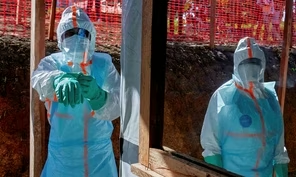
More than 340 cases have been confirmed and the outbreak has crossed into neighboring Uganda, worsening the challenge of containing the deadly disease in a region already riddled with conflict, displacement and strained health care systems.
To get a view from the ground, we turn to special correspondent Chris Ocamringa in the DRC's capital, Kinshasa.
And to give you a sense of the scale of the challenges moving about the DRC, Kinshasa is about 950 miles from the epicenter of the outbreak in the country's northeast.
That's roughly the same distance between Jackson, Mississippi, and Washington, D.C.
Chris, thank you for being with us.
Bring us up to speed.
What do we know about the scope of this outbreak right now and how concerned health officials are about it?
CHRIS OCAMRINGA: Well, health officials in the Democratic Republic of Congo are struggling to contain this outbreak that has spread rapidly since it was declared on May 15.
Back then, health officials told us that there were only three areas that registered cases, Rwampara, Mongbwalu, and Bunia, the capital of North Ituri province in the northeast of the country.
But now there are more than 20 health zones that have recorded cases.
We have been told that there are 60 people who have died and 344 others who are infected with this very contagious disease.
Last week, many health facilities there were overwhelmed by the number of people who were brought in with suspected cases.
They had to turn away some people because they didn't have enough beds.
So there was an appeal that was made, and the international community really came to the rescue of authorities in the DRC.
Millions of dollars have been raised.
We have seen medical supplies being airlifted to Ituri province, the epicenter of this outbreak.
People now have set up new treatment centers, and they're now trying to scale up the response to this outbreak before it claims more lives -- Geoff.
GEOFF BENNETT: Setting up these new treatment centers, containing Ebola is in many ways a race against time.
What are the biggest obstacles health workers face in identifying cases and tracing contacts and stopping transmission?
CHRIS OCAMRINGA: Well, one of the major challenges that they're facing is that this outbreak has occurred in active conflict zones.
There are lots of rebel groups in that area Ituri.
They are CODECO.
There's Allied Democratic Forces, Zaire, and a number of other militia groups that have been attacking civilians, forcing them to flee to displaced camps.
And these are crowded camps where people are crammed together.
They cannot keep a social distance.
And that's a fertile area for the spread of infectious diseases.
So health workers are very concerned about the continuous violence in the east and northeast of the DRC, where there are a number of rebel groups.
This outbreak has also been recorded in another part of the DRC, in the eastern part, where there are rebels known as M23 who are controlling large swathes of that area.
So it's very difficult for health workers to carry out content tracing, which is a very important element about containing this Ebola outbreak.
It's about tracking people who got - - came into contact with those who have been confirmed to have Ebola.
And it means moving from one place to another.
That can only be done when there's peace in that area.
So the DRC government and international partners have been appealing to all the warring parties, the militia groups in that area, to cease fire, so that health workers can be able to reach out to these patients and provide treatment so that this disease does not spread further -- Geoff.
GEOFF BENNETT: We have the benefit of having you on the ground in Kinshasa tonight doing this reporting.
Beyond the medical toll, how is this outbreak affecting daily life in the communities at the center of it?
CHRIS OCAMRINGA: Well, it has really disrupted the daily lives of the people.
This area, Ituri province, is a region that borders two countries, South Sudan and Uganda.
And those people in that area don't have very many formal jobs.
So they engage in petty trade.
So there's a lot of cross-border trade between the people of these three countries, the Democratic Republic of Congo.
People keep traveling to Uganda and South Sudan.
And now that this outbreak has really spread, Uganda has shut its border with the DRC.
And they have also -- South Sudan is also closely monitoring the developments here.
So many people have really been hit hard by this development.
They cannot make any money.
And the World Health Organization has always been appealing to countries not to close their borders.
They're saying that's an issue that will really disrupt the livelihoods of very many people; what they should do is step up screening at the border crossings and also surveillance so that they can treat these suspected cases.
But every country has its own decision.
It's a sovereign decision about how they want to deal with this outbreak.
And, so, many people in the DRC have really been affected by this Ebola outbreak.
GEOFF BENNETT: Special correspondent Chris Ocamringa in the Democratic Republic of the Congo reporting from Kinshasa tonight, thank you.
And we will be back shortly to hear from some of this year's high-profile commencement speakers.
AMNA NAWAZ: But, first, take a moment to hear from your local PBS station.
It's a chance to offer your support, which helps to keep programs like this one on the air.
For those of you staying with us, we take another look now at the career of acclaimed mezzo-soprano Denyce Graves, who retired from the operatic stage earlier this year and is now devoting herself to teaching the next generation.
GEOFF BENNETT: Senior arts correspondent Jeffrey Brown joined Graves in the days leading up to her farewell for our arts and culture series, Canvas.
JEFFREY BROWN: In opera, Denyce Graves says there's enormous focus on how to make it, but not so much on how or when to leave it.
DENYCE GRAVES, Opera Singer: With all of the preparation and with all of our attention sort of centered around, what does it take to actually get into the world's greatest opera house, what does that require?
DENYCE GRAVES: And then, when you're there, when is it time, after you have done that -- if you're lucky, when is it time to sort of bow out gracefully?
JEFFREY BROWN: There's not a lot of guidance for that.
DENYCE GRAVES: Nope, not at all.
JEFFREY BROWN: Now she's done just that with a final series of performances in George Gershwin's classic "Porgy and Bess," reprising a role in a production first presented in 2019 at The Metropolitan Opera, one of the grandest stages of all.
JEFFREY BROWN: It was a supporting, not starring role.
And that, she told us with a laugh in The Met's renowned hall just days before her final time on stage, came with implications behind the scenes.
DENYCE GRAVES: When I started here, I had the first dressing room, right?
DENYCE GRAVES: And now it's the last one.
It's the last one.
There's nothing else after it.
JEFFREY BROWN: That's a sign.
DENYCE GRAVES: The next thing is out of the door.
There's no other dressing room after that one.
Like, it's the end of the line.
JEFFREY BROWN: So it's time.
DENYCE GRAVES: It's time.
It's time.
JEFFREY BROWN: And, at 61, she's doing it on her terms, publicly announced in a recent New York Times essay.
And it's not about dressing rooms, of course, as much as the extraordinary physical and emotional demands of her profession.
DENYCE GRAVES: This is very unnatural what it is that we do and the amount of discipline, the amount of training, the amount of sacrifice that it takes.
It's one that asks for your entire being.
Everything that you do affects what happens, because you are the instrument.
JEFFREY BROWN: Perhaps her best known role was the fiery, sensual Carmen in Georges Bizet's opera.
But she told us of being a shy and awkward child growing up in what she calls humble surroundings in Washington, D.C.
Among her role models, legendary soprano Leontyne Price, whom Graves first encountered in high school listening to recordings.
DENYCE GRAVES: And I discovered this art form and I said, what is this?
I'd never heard anything like that before.
I saw this woman who looked like me, and I said, what is this?
And I said that's what I want to do.
I want to do whatever it is that she's doing.
JEFFREY BROWN: So then, to make it, it must require drive, ambition.
DENYCE GRAVES: Oh, you better believe it.
JEFFREY BROWN: And do those come with doubts and anxieties and fears all along the way?
DENYCE GRAVES: Sure.
A fire has to be ignited inside of you somewhere and you have to believe that you have something unusual to offer.
JEFFREY BROWN: In the New York Times piece you wrote announcing the retirement, you said that, as a Black woman, you write of the difficulties "of pursuing life in a culture that often seemed foreign to me or that saw me as foreign to it."
DENYCE GRAVES: Absolutely.
I remember looking once at a production photo of myself on the stage with my colleagues and how different I was from everyone else, and some directors who would say to me: "There's no way you're going to be believable in this character."
JEFFREY BROWN: As a white European character?
DENYCE GRAVES: I mean, I had -- I can say these things now, I guess, maybe, maybe.
But I had the director at the Vienna Staatsoper, one of the world's greatest opera houses, said to me: "There's no way that I would hire you for like 99 percent of the roles here, because you just would not be believable."
And we were talking about Mozart's "Cosi fan tutte," in which I would sing the role of Dorabella.
He said: "Nobody would believe you as a sister."
And I said: "Well, I could be adopted or she could be adopted."
JEFFREY BROWN: Graves says the world of opera has changed a lot in terms of the stories being told and greater representation on stage.
And that's been part of her work with her foundation, to which she will now devote much of her time, and focus on training and mentoring a new generation of singers, including at historic Black colleges and universities.
Another focus, helping to preserve history as an advocate for the restoration of the former National Negro Opera House in Pittsburgh once home to an organization started by singer Mary Cardwell Dawson, who, feeling shut out of most opera companies, decided to start her own.
DENYCE GRAVES: I was so moved by her and her story and by the fact that I didn't learn about her.
She's a great, great hidden figure who really changed in the shape of the landscape of this profession.
WOMAN: In the very best sense of the word, you are one of our divas.
DENYCE GRAVES: Oh!
WOMAN: Yes.
JEFFREY BROWN: Graves is leaving behind legions of colleagues, including in The Met's costume and wig shop, but looks forward to continuing to coach singers and a new pursuit, direct operas.
But, on January 24, it was time for a final performance as a singer and on-stage celebration.
DENYCE GRAVES: I'm incredibly grateful and feel incredibly fulfilled.
I did many of the roles that I wanted to do.
And when I look around me on the stage, I see another generation.
JEFFREY BROWN: For the "PBS News Hour," I'm Jeffrey Brown at the Metropolitan Opera in New York.
GEOFF BENNETT: Over the past month, college seniors have been donning their caps and gowns to mark the end of one chapter and the beginning of another.
They're facing a daunting future, entering a rapidly transforming job market, thanks to artificial intelligence, global unrest, and a host of other factors.
AMNA NAWAZ: It was against this backdrop that graduation speakers took to the stage to provide their best advice with honesty, passion, and humility.
Here now are some notable speeches you might have missed.
QUEEN LATIFAH, Musician: I was thinking about what I would say to you today, what advice I would give you in terms of life advice, career advice, what I would say to myself if I were your age or if it were my son graduating.
And I would probably tell you, it's scary out there!
TOM BRADY, Former NFL Quarterback: Overcoming fear and doubt in the face of those challenges is where you're going to gain the confidence to make your best choices when things aren't going the way you want.
You may only get one chance to impress your boss or land a promotion, or to close a deal or not.
So what then?
You better have prepared yourself in advance to deal with the adversity you're going to face in order to give yourself the best chance to succeed.
HODA KOTB, "The Today Show": Your trip's not someone else's trip.
Don't worry about who's next to you.
Don't worry about if they get promoted before you.
Don't worry about if they get a house first.
You run your race, OK?
All of my blessings happened after 50.
I know it sounds weird, all of them.
I got the job of my dreams at "The Today Show."
I got the family I have dreamt of.
I have two kids now.
Your blessings come when they come, and they come right on time.
ERIC CHURCH, Musician: Your generation faces a temptation no generation before has ever faced, the temptation to perform for everyone and belong to no one, to be globally visible and locally invisible, to have thousands of followers and no one knows actually where you live.
Resist this.
Plant yourself somewhere.
Put down roots with the full intention of growing there.
HILARY DUFF, Actress: Redirecting your energy in one area can mean sprinting in another.
The key is that I was choosing where my energy went, instead of letting others choose for me.
A wonderful part of giving yourself that space is you can look back and see the distance you have traveled.
ANDY COHEN, Executive Producer, Bravo TV: Success is building a community and keeping that community close.
Cherish your community.
It will become the fabric of your life.
Nurture your friends and acquaintances.
Stay in touch.
Be kind.
Reach out.
Check in.
Be the person that's there for others.
Show up.
CONAN O'BRIEN, Former Host, "Late Night With Conan O'Brien": I honestly believe that community, spontaneity, and a real commitment to humility has helped me build a rich life that means much more to me than any diploma.
And, believe me, I'm not saying the goal is to renounce accomplishments, but rather to metabolize them.
If you carry your victories lightly, other qualities, kindness, originality, courage, humor, and humanity, have room to emerge.
GEOFF BENNETT: All great advice.
Well, that is the "News Hour" for tonight.
I'm Geoff Bennett.
AMNA NAWAZ: And I'm Amna Nawaz.
On behalf of the entire "News Hour" team, thank you for joining us.

60 Minutes' in turmoil after correspondent Pelley is fired
Video has Closed Captions
'60 Minutes' in turmoil after longtime correspondent Scott Pelley is fired (7m 26s)
Absence of New Jersey congressmen raises broader questions
Video has Closed Captions
Republican Rep. Tom Kean Jr.'s absence raises broader questions about Congress (5m 7s)
Dissecting what the latest primaries mean for November
Video has Closed Captions
Dissecting what the latest primary races mean for November elections (6m 48s)
Health workers struggle to contain Ebola outbreak
Video has Closed Captions
Health workers struggle to contain Ebola outbreak (5m 24s)
Iranian strikes hit Kuwait's largest airport amid ceasefire
Video has Closed Captions
Iranian strikes set Kuwait's largest airport ablaze amid fragile ceasefire with the U.S. (5m 13s)
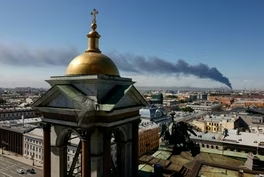
News Wrap: Ukraine strikes oil depot deep inside Russia
Video has Closed Captions
News Wrap: Ukraine strikes oil depot deep inside Russia (6m)

Noteworthy speeches from recent college graduations
Video has Closed Captions
Noteworthy speeches from recent college graduations (3m 27s)

Trump administration cuts ambitious ocean monitoring program
Video has Closed Captions
Trump administration dismantles ambitious ocean monitoring program (5m 23s)
Providing Support for PBS.org
Learn Moreabout PBS online sponsorship New Episode
- News and Public Affairs

Today's top journalists discuss Washington's current political events and public affairs.
 New Episode
- News and Public Affairs

FRONTLINE is investigative journalism that questions, explains and changes our world.

 New Episode
 New Episode
 New Episode
 New Episode

 New Episode
 New Episode
 New Episode
 New Episode
Support for PBS provided by:
Major corporate funding for the PBS News Hour is provided by BDO, BNSF, Consumer Cellular, American Cruise Lines, and Raymond James. Funding for the PBS NewsHour Weekend is provided by...