
Readers Club Episode 309 Hollow Bones | Jodi Picoult
Season 2026 Episode 28 | 46m 12sVideo has Closed Captions
PBS Books Readers Club welcomes prolific author Jodi Picoult to discuss her newest novel
PBS Books Readers Club welcomes prolific author Jodi Picoult to discuss her newest novel Hollow Bones. Hollow Bones follows 25-year-old Molly Fitzgerald, the youngest director of the Rhode Island Department of Emergency Preparedness, whose job is to imagine the unimaginable: storms, epidemics, plane crashes, and other worst-case scenarios, in order to create plans that could save lives.
Problems playing video? | Closed Captioning Feedback
Problems playing video? | Closed Captioning Feedback
Readers Club Episode 309 Hollow Bones | Jodi Picoult
Season 2026 Episode 28 | 46m 12sVideo has Closed Captions
PBS Books Readers Club welcomes prolific author Jodi Picoult to discuss her newest novel Hollow Bones. Hollow Bones follows 25-year-old Molly Fitzgerald, the youngest director of the Rhode Island Department of Emergency Preparedness, whose job is to imagine the unimaginable: storms, epidemics, plane crashes, and other worst-case scenarios, in order to create plans that could save lives.
Problems playing video? | Closed Captioning Feedback
Where to Watch PBS Books
PBS Books is available to stream on pbs.org and the PBS app.
Providing Support for PBS.org
Learn Moreabout PBS online sponsorshipMore from This Collection
The PBS Books Readers Club is a monthly digital-first series that brings its members into conversations behind the stories of your favorite books & shows. You can watch the online on the PBS App, with extended interviews available for PBS members on PBS Passport.
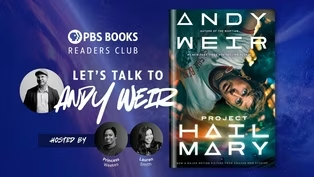
Video has Closed Captions
PBS Books Readers Club welcomes author Andy Weir to discuss his best-seller Project Hail Mary (40m 24s)
Readers Club Episode 307: Booking It Across America
Video has Closed Captions
This month, PBS Books Readers Club celebrates America 250 with a special episode (15m 49s)
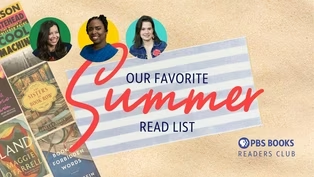
READERS CLUB Episode 306 : Our Favorite Books for Summer
Video has Closed Captions
Our hosts of the PBS Books Readers Club, share their perfect picks to binge beachside this summer (18m 45s)
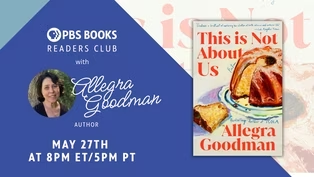
Readers Club 305: This Is Not About Us | Allegra Goodman
Video has Closed Captions
New York Times bestselling author Allegra Goodman of Sam and Isola to discuss her brand-new novel (36m 31s)
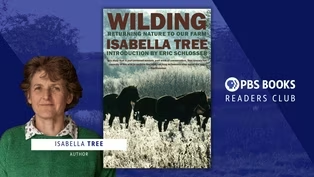
Readers Club 304: Wilding | Isabella Tree
Video has Closed Captions
PBS Books Readers Club welcomes British author and conservationist Isabella Tree (33m 17s)
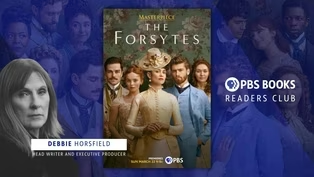
Readers Club- Debbie Horsfield | The Forsytes
Video has Closed Captions
The PBS Books Readers Club takes on John Galsworthy's classic novel series The Forsytes. (32m 36s)

Readers Club | 302 Book Picks for Black History Month with Lauren Smith and Princess Weekes
Video has Closed Captions
PBBS Books Readers Club recommend their favorite Black History Month reads. (16m 16s)
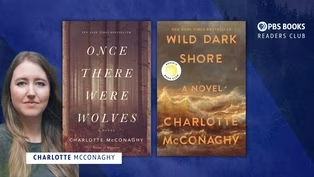
Readers Club | Ep 301: Charlotte McConaghy | Once There Were Wolves
Video has Closed Captions
PBS Books Readers Club hosts author Charlotte McConaghy to discuss her novel Once There Were Wolves. (58m 55s)
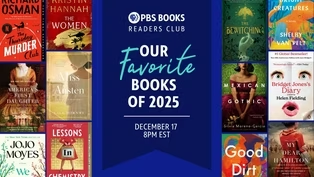
Readers Club | Ep. 212: Our Favorite Books of 2025
Video has Closed Captions
PBS Books Readers Club celebrates the wrap of its second season with a highlight of 2025 (47m 55s)
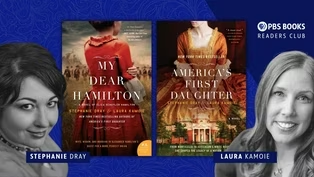
Readers Club | Ep. 211: America's First Daughter | Stephanie Dray & Laura Kamoie
Video has Closed Captions
PBS Books Readers Club welcomes co-authors Stephanie Dray and Laura Kamoie (1h 1m 45s)
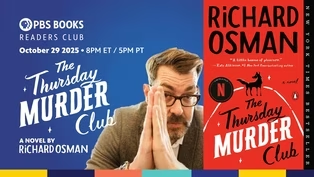
Wed Oct 29 2025 | Readers Club | Ep. 210: Richard Osman | Thursday Murder Club
Video has Closed Captions
PBS Books Readers Club welcomes celebrity writer Richard Osman to discuss his best-selling novel (52m 44s)
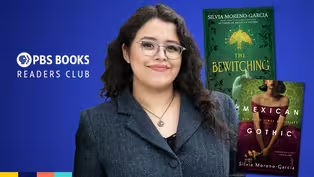
Readers Club | Ep. 209: Silvia Moreno-Garcia | The Bewitching and Mexican Gothic
Video has Closed Captions
PBS Books Readers Club welcomes award winning author Silvia Moreno-Garcia to discuss her new book. (52m 42s)
Providing Support for PBS.org
Learn Moreabout PBS online sponsorship(bright music) - Joelle wrote me from jail, where she's awaiting trial because she killed her three-year-old daughter while she had postpartum psychosis.
And she said to me, "I've read so many of your books.
Will you be my voice?
You've been the voice of others."
I really hope that this book does what she hoped it would, which is to raise awareness and maybe to save one woman from going through what she did.
(bright music) - [Announcer] This program is brought to you in part by Libro.fm.
Libro.fm partners with more than 4,000 bookstores around the world to sell audio books, encouraging more people to read while supporting local independent bookstores.
- Well, hello, and welcome to the "PBS Books Readers Club."
I'm Fred Nahhat here with Lauren Smith.
Today, we are excited to welcome bestselling author, Jodi Picoult.
You might know her from some of her other bestsellers, like "Nineteen Minutes," "Small Great Things," and "My Sister's Keeper," of course.
Well, today, we're gonna talk to her about her brand new novel, that's it, "Hollow Bones."
- Oh, it's fantastic.
If you're a Jodi Picoult reader, you're gonna love this new book.
I think it has more twists and turns than any of her other books.
It's really good.
When Molly Fitzgerald was just two months old, her mother was killed in the September 11th attacks.
Decades later, Molly has built a career preparing for disasters, convinced that careful planning can keep tragedy at bay.
But when the unexpected upends her life, she is left questioning everything she thought she knew about family, love, and control.
- "Hollow Bones" is a powerful tale moving through past and present, shedding light on the bonds of mother and daughter.
It's complicated, it's vulnerable.
And as Jodi always delivers, full emotional depth and compassion.
- Have you had a chance to read it yet?
I know it's just fresh out, but I'm sure many of you got it right off the shelves.
Don't worry, there won't be spoilers here in case you haven't read it yet.
But we'd love to know what you though about it in the chat or comments, if you've had a chance to read it already.
Also, let us know what you thought of Jodi's previous novels.
Everyone has a favorite Jodi Picoult book.
We'd love to know what yours is.
We'll talk with Jodi Picoult in just a minute.
But first, Fred, what did you think of the book?
- Well, I just think, right off the hop, the connection to the September 11th terrorist attack.
It defined my generation, Generation X. We were young adults moving into, you know, our family lives.
And for you, I would imagine, as a Millennial, it kind of defined the early stages of your life.
- Absolutely.
- And all of these years later, Lauren, we are still grappling with the issues that led up to 9/11, that consumed us during those weeks after, and of course, in the aftermath, in the knowing, in the finding, and theorizing.
And this is just an incredible twist on an American tragedy.
- Yeah, the other theme that she explores really deeply in "Hollow Bones" that I related to so much as a mother is the postpartum psychosis tragedy that many women experience.
And I don't know how she planned this, but there are so many headlines on the topic right now.
And it was really interesting to take a deep dive into that theme in "Hollow Bones."
- Well, she has a unique knack for timing, but I guess, when your subject is human sensibility, timing is always on your side.
Well, Jodi Picoult is standing by to join us in just a moment, but first, make sure you stay in the loop on all of our "PBS Books Author Talks" and more.
Sign up for our "PBS Books" e-newsletter at pbsbooks.org/subscribe for exclusive recommendations, author interviews, and much more.
And subscribe to the "PBS Books" YouTube channel so you never miss an episode of the "PBS Books Readers Club."
Jodi Picoult is standing by to join us in just a moment.
But first, a quick reminder that "PBS Books" is supported by viewers like you.
Help keep this show and all of the other bookish content you love coming by visiting pbsbooks.org/donate.
You will be taken to your local station's giving page where you can select one of our special "PBS Books Readers Club" gifts as our thanks.
- And check this out.
We have an all-new "PBS Books" mug.
Is this not the cutest thing you've ever seen?
We designed it ourselves right here, and we think it is adorable.
I would like to replace all of my mugs with this one.
We hope that you like it too.
Plus we're releasing for the first time, the "PBS Books" reading blanket.
It's super soft, not too heavy, and will keep you nice and snug while you cozy up with your next great read.
We have one back here, actually.
You can kinda see it.
It's very soft and snugly, and I think that you're gonna love it.
We also have the "PBS Books Readers Club" book bag, my favorite, is the perfect companion for all of your library halls.
I'm obsessed with mine, I use it all the time.
- And of course, "PBS Books," as we mentioned, is supported by viewers like you, now more than ever, so we need your help.
So please make a gift today by going to pbsbooks.org/donate.
And now, let's turn the page as we welcome our guest this month, author of "Hollow Bones," Jodi Picoult, welcome to the "PBS Books Readers Club."
- Thanks for having me.
- Well, first of all, congratulations on your 30th novel.
What an accomplishment.
- Crazy, I know.
(laughs) - [Lauren] That must feel amazing.
- It does, it's, you know, I don't know where the time went.
It's crazy to have 30 under my belt.
- Well, we loved "Hollow Bones," it's very powerful.
It's just new out, so for those readers that haven't had a chance to read it yet, tell everybody what it's all about in your own words.
- So it's the story of a woman named Molly Fitzgerald, who was two months old when her mom went to a doctor's appointment on 9/11 and never came home again.
And we meet Molly 25 years later, when she is grown up, and she is married to Jesse Fitzgerald, who's a character from one of my other books, "My Sister's Keeper," and they're about to have a baby.
And she is the head of Emergency Preparedness and Response for the State of Rhode Island.
Basically, she spends her whole life trying to make sure that others don't experience the kind of tragedy that she did growing up, but disasters have a way of happening.
And when one happens really close to home, she realizes that you can prepare for anything except for the things that you don't see coming.
- And one of those things, of course, is grief.
And that is a theme explored in the book, grief as a child, but always just outside the door, even as she creates a life trying to prepare for disaster, grief is her constant companion.
- Yeah, you know, to me, I think, when I think about what I want people to come away with from this book, there's so much in it, and there's so much in there about motherhood, about the lies that we tell to protect the people we love, about gender discrimination in healthcare.
But I think what I want people to leave with is that sense that people, we'll always lose people we love, right?
But we also find ways to carry them with us.
- Well, let's talk a little bit about the character, Jesse, for a minute, Molly's husband.
And like you said, a callback character from "My Sister's Keeper."
Why did you feel like he was the right partner for Molly?
And, I mean, everybody loves that book.
Did you just wanna do us a favor by bringing him back?
- (chuckles) I mean, yeah, a little bit.
I kind of wanted to give my readers like a little bit of a gift.
There are some characters that I've written that, you know, even years after the fact, when their book is finished, I kind of wonder, "Hmm, I wonder how so-and-so's doing now."
And with Molly, when I knew that she was going to be the head of this very real organization in Rhode Island, I immediately started thinking about "My Sister's Keeper" because it's the only other book that I've set in Rhode Island.
And then I started to think, "Huh, wonder what the Fitzgeralds are doing now."
And I began to think about Jesse, who I always wondered kind of how he grew up.
And Jesse was in "My Sister's Keeper."
He's the brother of these two central figure sisters.
And he's a bad boy, he's a teenager, he's an arsonist, he does everything wrong, but he has a heart of gold.
And I always thought he would grow up and become a member of law enforcement.
And that is, in fact, what he does in "Hollow Bones."
He actually is the chief polygrapher.
He runs lie detector tests for the Providence Police.
And I thought, you know, "Who better to spot a liar than a former liar," right?
And it was amazing to get to do all that research too.
I mean, like, do you know that 60% of people can't go 10 minutes without lying?
- Ooh.
(laughs) - You know.
- That's tough to hear.
(laughs) - Yeah, so I don't know what I'm gonna say during this interview, but... - Have you lied yet?
I don't think so.
- I don't think so, not yet.
(laughs) - Well, I can relate to that.
- Yeah, but it was really, it was wonderful to learn how he would do his job.
I got to work with this deputy sheriff who is in charge of lie detection in this area in New Hampshire, who, you know, hooked me up to this machine, showed me how to run it.
And, you know, I was convinced I was gonna beat this lie detector test 'cause like, there are stakes, right?
And he did what's called an acquaintance test, where basically, they say, you know, he goes, "This is the only time I want you to lie.
Pick a number between one and 10.
I'm gonna ask you for each number.
When I get to your number, lie to me."
And, you know, I'm hooked up to all this stuff, and we get to number four, which is my number, and very coolly, I go, "No, that's not my number."
And sure enough, then he shows me at the end of the test how, literally, I spiked off the chart and completely off the chart.
- Oh my god, even though you knew that you were lying, like you have nothing to hide, that's crazy.
- I mean, it wasn't high stakes either, it was a number.
You know, but my advice to all of you is don't try to lie on the lie detector test.
- Noted, I hope I don't find myself in a situation where I need to take one, but good to know.
- Exactly.
- Boy, that's so true.
Well, where there is lies and truth, there is true and false, but then there's these subtleties, these self-narratives, these stories we tell each other, these stories we tell ourselves, and over time, it becomes our truth.
And this is just another gray area you're exploring in "Hollow Bones."
- Yeah, there's so much I can't say about this book 'cause there are so many spoilers.
But yes, there are definitely, there are ways that we rewrite our histories, I think, to make it more palatable for ourselves and for the people that we love.
And one of the things that I explore in great depth in this book that is quite timely at the moment is postpartum psychosis.
And I talk about it in relation to certain characters in the book, and of course, this is something that we've been seeing a lot of because of the Lindsay Clancy trial.
You know, this is an illness that hits one in 500 women.
Most of the people who suffer from it have never had a psychiatric episode ever in their lives.
It's a mood episode, and it's characterized by paranoia and disordered thinking and by command hallucinations.
You're hearing voices in your head telling you to do something.
And if it's left untreated, it can often lead to infanticide and to suicide.
You know, and the problem with postpartum psychosis is that it's really hard to get a diagnosis because first of all, when a new mom goes to a doctor and says, "I'm having these terrible thoughts about my baby," what are they gonna say?
"Oh, you're a new mom, everyone thinks that.
Relax," right?
- Yeah.
- So women are kind of dismissed, and they're trying to get healthcare.
Add to that the fact that the DSM-5 does not consider postpartum psychosis its own diagnosis.
And the fact that one of the hallmarks of this illness is that you can be psychotic one moment and completely lucid the next.
And that looks a lot like planning or, you know, a forethought if you're looking at it from a legal perspective, which is what makes it so difficult if you get to a position like where Lindsay Clancy is.
So this is, again, something that I really do a deep dive into in this book, and it's really heartbreaking.
The thing that shocked me the most is that if you do manage to get somebody to try and say, "Okay, well, maybe you do have something wrong with you," the assumption is made that you have postpartum depression because that's far more prevalent, and they'll put a woman on an SSRI.
Now, if you have postpartum psychosis, that will make you feel like you're being burned alive from the inside out, and your thoughts will become even more disordered.
So literally, to diagnose these women, we have to make them suffer even more.
It's just, it's really tragic.
- That really stuck with me as well, that concept.
I've been talking about it ever since I finished your book.
Talk a little bit more about your inspiration for writing this.
You gave us a little clue at the end of the book in terms of how you were inspired, but if you can, tell us a little bit more about that.
- Yeah, so when I started to think about this as becoming an element for "Hollow Bones," I received, sometimes like the universe just provides, and I literally received a letter from a woman who we'll call Joelle by her own request to keep her name private.
Joelle wrote me from jail where she's awaiting trial because she killed her three-year-old daughter after giving birth to a newborn son while she had postpartum psychosis.
And she said to me, "I've read so many of your books and so much went wrong in my diagnosis and, you know, everything that led to this moment.
Will you be my voice?
You've been the voice of others."
And I wound up doing, I don't know, I would say, we went back and forth by mail.
I had over 200 pages of letters back and forth with her, where she was very honest and straightforward and detailed about everything that led to the moment when she killed her daughter and what's happened since then because, again, one of the really sad things about postpartum psychosis is that once it's diagnosed, it's very easy to regulate.
And now she is fully aware of what she did, and she will live with that for the rest of her life, you know, no matter what, and it's just a real tragedy.
I really hope that this book does what she hoped it would, which is to raise awareness and maybe to save one woman from going through what she did.
- Yeah, I'm always curious about process.
Part of that creative process is, of course, let the universe provide, but also the other side of that, and you're well known for this, well researching topics to provide that authenticity.
Talk a little bit about the depths you travel to make sure the experience of your novels is authentic.
- Yeah, I would just say, I think a lot of people that I talk to, every book that you write, I feel like not only is it a great story, but we learn something new, like a deep dive, whether it's beekeeping or disaster prevent, like it's so, we love that about your books.
And I think a lot of people assume you must have a team of researchers that are just going out and doing this, like, what, tell us, what's the scoop?
How does this happen?
- I don't even have an assistant.
I mean, this is it, this is me, I do it all.
For me, that's part of the fun of writing a book, it's getting to know a character so well that I can speak authentically for them, and that often involves learning something I don't know.
You know, for this book, I talked to you a little bit about two areas of research, but a great deal of time was spent working with the actual director of Emergency Preparedness and Response for the State of Rhode Island.
Her name is Alysia Mihalakos, and she's incredible.
And, you know, she has done everything, everything from the entire COVID rollout for the state to having to evacuate nursing homes when there are power outages because the people who live inside them have no heat, you know, no water, no electricity, to having to brainstorm a way to get a ward of the state, who was like over 600 pounds, out of an upper floor care facility that he couldn't even fit through the door anymore.
They had to literally dismantle the house, put him on a flatbed truck and move him to another facility.
I mean, these are the crazy kinds of things that she has to do every single day.
And, you know, the thing that struck me the most about her is that she is worrying constantly so that we do not have to.
You know, I remember her- - Thank you.
- Talking about, right, yeah.
I remember her talking about like having to come up with a plan about how to evacuate a high-level neonatal ICU.
Now, if you've ever been in one, you know, you know that there are newborns in all different stages of compromised care, from just needing, you know, some kind of breathing tube to some that literally have organs hanging outside their body and are waiting to get big enough for a surgery to put them inside.
So what happens if there is some tragedy, and those babies need to be moved?
How do you do that?
How do you even put an isolette down four flights of stairs if the elevator's broken?
What do you do if you put it into an ambulance?
There's no way that you could keep a, you know, baby safe if it's sliding all over in an isolette.
Is it more humane to tell the parents, to say, "Don't move my child, let me say goodbye."
I mean, these are the horrible ethical questions that she has to deal with every day.
And, you know, it just made me realize that the field of public health is so much bigger than we think, and it was great to write about it right now because they also are facing so many challenges in the field of public health because there is so much public mistrust left after COVID, and this belief that private opinion, personal opinion, somehow trumps science has really made it very difficult to work in that business.
So it was great to be able to shine a spotlight on that too.
- Shine a spotlight, but the other thing you're well known for is letting folks sit with a point of view, that empathy, not necessarily advocating for one position or the other, but just being in that space and taking on that emotion.
Talk about that aspect of your writing.
- I don't think it's my job to tell you what to think.
Look, I'm super opinionated, I'm very political.
You could go to any of my social media if you wanna hear that.
But I think it's more important for me to get a reader to say, "What is my opinion, and why is my opinion what it is?"
'Cause, you know, most of us kind of form opinions about controversial topics very young because our parents have those opinions, our clergy has those opinions, our friends, and then we don't revisit that the rest of our lives.
And what I like doing in my book is providing all the different facets of a difficult situation or a difficult, controversial topic, and then letting you sit back and ask yourself, "Is my opinion still valid?
Have I ever heard what the other side had to say before?"
You know, I think that kind of dialogue is incredibly important when the world feels very fractured.
You may not change your mind, and that's okay.
But if you're willing to listen, that's also a first step.
- The other interesting theme that you tackle in "Hollow Bones" is reflecting on the anniversary of September 11th, which 2026 marks the 25th anniversary, and how, specifically, in this book, it affects the character of Molly because she was so traumatized by what happened to her own family.
But interesting to reflect back on how that event still lingers in our culture today.
- It totally does.
I wanted this book to come out this year, like that was my goal, to write about 9/11 in 2026 because it's the 25th anniversary of the attacks.
And like you said, it is still so much with us.
You know, on a very personal and practical level, the survivors of people who were lost in 9/11, more than 40% of them are still waiting for any kind of remains to be identified.
I mean, that is how slow the process has been.
It's been 25 years.
But even if you didn't lose someone personally on 9/11, if you were alive, you know where you were, right?
Like I remember exactly where I was when the planes hit, and I remember what I was doing, and I remember how old my kids were, and I remember my son having nightmares, you know, because he had seen some of the television footage with people who were leaping off the buildings.
I remember all of that so concretely.
And when you write a book like this, you're almost inviting the reader to bring their own memories back to be part of the equation because everyone is gonna be carrying something about 9/11 to this book before they even crack the first page.
- Yeah, I remember, for me, I was in high school, and I came home from school that day, and my mom was canning tomatoes in the kitchen.
And like, the smell of the cooked tomatoes, like if I smell that now, I go right back to that day and that feeling, like tomatoes is the smell of fear (laughs) to me.
- Yeah, yeah, right?
- A beautiful, beautiful cold September morning.
My son was four.
- Yep.
- I was the first to pick him up from daycare 'cause I thought this was crazy.
Someone came into my office and said, "A plane just hit the tower."
And then we watched the second one hit, and I still, still today.
- Get goosebumps, right?
- Yeah.
- Yeah, yeah.
I was- - Crazy.
- I remember being up in my office, I was working, and my mom, who lived in Arizona, so she was three hours earlier, it was 6:00 AM in Arizona, and she called me up, and she knew I didn't wanna talk when I was working, and I was like, "So why are you calling me?"
And she said, "Go turn on the TV."
And I went and turned on the TV, and I turned it on just in time to see the second plane hit.
And I yelled out, same thing, I know exactly where I was standing, I yelled out the window to my husband who was gardening.
And I said, "You need to come in here right now."
And the two of us just stood in the bedroom, watching this unfold.
You know, I mean, and I still remember, remember driving around one of the rotaries in our town when I was going to pick the kids up at school and thinking, "Are we at war?
Like what's happening now?"
Like we didn't know, you know?
- Yeah.
- So yeah, revisiting that was very powerful.
- Yeah, very, very powerful, and of course, 9/11, the time, the setting all goes to story development and character development.
Not a giant leap, someone who has experienced a tragedy or trauma in childhood, to be an emergency preparedness director, I wouldn't guess.
- That's, yeah.
- So solid.
But also, you can, through physics and chemistry and MacGyvering plans, you can figure out how to save people, but in your own emotion, your own personal tragedy, there's no blueprint.
- Yeah, yeah, and I really did wanna kind of address that too, the difference between a public tragedy and a private tragedy because here's Molly, you know, who grows up with this very real loss, and she's a kid.
You know, we all followed them.
I'm sure you read stories about the kids who lost parents on 9/11, right?
For years, media would follow them.
And I remember reading them, and I thought, "How weird it must be to grow up without a mom and to have this hole in your life, but to know that the whole world is watching you grieve."
You know, that felt to me like such a dissonance, and I really did want to explore that.
- Another really interesting theme in this book is we talked a little bit about the lie detector test and truth and lies, but the gray area here is, is it ever kinder to lie to someone that you love?
Talk a little bit about that theme.
- Yeah, you know, yeah, absolutely, what are the reasons that we lie?
We lie for reassurance, we lie for self-preservation, and we lie for compassion.
So, you know, think about it, when your wife comes out in a dress and says, "Does this make my butt look fat?"
What are you gonna say, right?
You know, and that's a different lie than, say, a lie like, you know, you might hear, I don't know, someone in the government say that it has effects, you know, that ripple down throughout people in America.
But you start to realize that in addition to the fact that we all lie, the more you tell lies, the easier it is to lie.
And the more that you lie, the more you convince yourself it's the truth.
So the more you do it, the more fluid a liar you become, which to me is crazy, but also when you start, you know, parsing it apart, you're like, "Yeah, actually, that tracks very well."
You know, I think that there are so many reasons in this book, and again, I'm like, trying not to say things 'cause I don't wanna give away big twists, but where the people who are lying are doing it for what they think are the right reasons.
And then it's up to you as the reader to decide whether that even, whether you should even qualify that.
Is the lie still a lie?
- Yeah, well, speaking of the big twists in the book, we won't reveal any spoilers here because we know it's brand new, but it leads me to wonder how you go about writing these books and your process.
Are you a planner?
Are you a pantser?
Do you know where it's going from the start?
Do you outline everything?
Tell us how you make this all happen.
- Yeah, I am such a planner.
I always have been.
(Lauren laughs) I mean, especially with a book with twists.
This has, I think, more twists than any of my books all put together, there's so many in here.
And I think that anyone can write a twist, right?
But if you don't leave breadcrumbs, then you're just really writing a sucker punch.
So I think my job is to make sure that I'm leaving you clues so that you can go back and go, "How did I miss that the first time around?"
You know, that to me is good writing.
So I make sure that I'm trying to do that.
In order to do that, I really do need to plot things out.
That's not to say that surprises don't happen when I'm writing.
Very often, characters will do something or say something that I'm completely not expecting and take me in a different direction, but I know I'm always headed towards that same kind of goal, that twist.
It's funny you ask that question because when I was working on a previous book, "Mad Honey," with Jenny Boylan, who I absolutely love.
- I love that one.
The beekeeping, I learned so much about bees.
I feel like I'm an expert now.
- Right, but "Mad Honey" is a mystery, and Jenny is not a plotter.
Jenny had never written an outline in her life, and she is what we call a pantser in the business.
And she was just, you know, going through writing her chapters.
And finally, I said, "Jenny, you cannot write a mystery and then get to page 400 and go, 'Well, I don't know who did it.'"
(Lauren laughs) You know, so sometimes it's a very practical reason to make sure that you outline.
- We've spoken to mystery writing pantsers, which blows my mind.
- Yeah, it's crazy.
- I don't know how they do it.
- No.
And to me, it feels like so much extra work, right?
- (laughs) Yeah.
- 'Cause you're gonna write yourself into a corner, and then you've got to back out.
So I don't have the time for that.
- It must be an adrenaline rush, I don't know how they do it.
(Jodi laughs) - Yeah, you know, I'm curious always about titles.
Why "Hollow Bones"?
- Mm, so there is a moment in "Hollow Bones" where one of the characters reflects on a memory and what they're remembering is being a child and seeing birds in a nest that were being pushed out of the nest by the mother, and it really freaked this child out.
And her own mom says, "Oh no," you know, "watch, it's gonna be okay."
And of course, the birds that are pushed out of the nest do manage to fly, and she points out that the things that make birds so incredibly fragile, which are "Hollow Bones," are also what make them able to survive to fly.
And that, for me, is a metaphor for the entire book.
- That's beautiful.
- Nailed it.
- I like that.
Yeah, okay, so tell us a little bit more about your sort of day-to-day life as a writer.
What are the parts that you love the most?
What are the most challenging parts?
And I'm sure, I mean, you put out so many books that you must be writing every day, but I'm just curious sort of how this all flows between concept to writing to publicizing the book.
Are you already writing something new while you're publicizing this book?
Like, please tell us everything.
- So, (laughs) it's, for me, it's very cyclical.
And so I am publishing a book every two years right now.
And so that means that if it's a writing year, then I am going to my desk every morning.
I get up, and I swim a mile, and that's how I start every day.
And then I go up to my desk, and I start writing, and I just pick up the chapter I was working on and work my way through it until I get to the end and keep going.
I usually write a normal day from like, you know, 8:30 to five o'clock, and then I like magically turn into a wife again and go downstairs.
You know, it's very, it's a job, I treat it like a job, but I do love the act of writing.
I mean, I wouldn't keep doing it if it wasn't fun.
But then, there is what happens in a year off.
And in a year off, I will be on tour and promoting that book when it comes out.
So like right now, I will be on tour for 2 1/2 months in a variety of countries, promoting this book.
And that means I'm in a different city every single day.
I'm doing one or two events a day.
I'm meeting thousands of readers, which I love doing because I love hearing how my stories have changed them.
That's like the last piece of the equation.
And also, for this, this tour is gonna be a blast.
We're calling it the Chapters Tour, not to be confused with a certain amazing recording artist who I love.
- (laughs) I like it.
- But, you know, the idea is we're celebrating all the chapters, all 30 of these books.
So I'm really excited about this tour.
It's gonna feel like a party.
But then, in a year like this, when I'm promoting, I will spend the beginning of the year working on the research for what's coming next.
So at this point on my laptop, I have 168-page, single-spaced outline for the book that will come out in 2028, and that is about AI.
- Oh, okay, we'll make a note.
Please come back to "PBS Books" and talk to us about it once you're ready.
- I would love to.
- Well, speaking of AI, I'm always looking for someone to help me illustrate something.
As a Gen Xer, you and I are probably similar in age.
I think your first novel came out right around when I started doing this.
At that time, no internet, no social media, no platform.
And yet here you are in your career.
You seem more enthusiastic and excited as ever, and taking advantage of all those platforms.
How did you receive this and turn it into an advantage?
And it seems like a passion.
- That's a great question because the industry for books changes, I swear, every two years.
You know, I will come back after publishing a book, and I'm like ready to go, and they're like, "Oh, no, no, no, this isn't selling books this year.
This is what's selling them."
You know, and so everything changes.
And social media changes too.
During COVID, I actually wound up getting a TikTok account.
And believe me, my children were not excited.
Here I was in my 50s, (Fred and Lauren laugh) and they're like, "You don't need TikTok."
But, you know, I did it because BookTok had become such a thing, and it was so organic to find these readers who just wanted to recommend things they love.
And I wanted to know if I could kind of crack that group.
And I wound up really enjoying doing stuff on TikTok.
You know, making fun of yourself is always good.
People like to see that.
And then I wound up, you know, doing political rants, and to my great shock, you know, I now get a lot of younger people who say, "Oh, I first found you on TikTok, and I liked what you were saying, so I started reading your books," which is exactly what you want.
You wanna use the social media so that the people who grow up with it find you.
- That's super cool.
- Very, very cool, and so before all of that, did you always know you were gonna be a writer?
- Yeah, I mean, no, the answer is I always wrote, and I loved writing, but I never thought I would make a living as a writer.
I mean, sometimes I still can't believe I make a living as a writer.
You know, even after 30 books, it is truly amazing to me that I get to go to my office and do what I love to do every single day.
How lucky am I, right?
And how lucky am I that people wanna read?
Wherever I wanna take them, they're willing to go.
I still remember the point in my career where I started to do the math, and I realized it couldn't just be my mom and her friends buying my books anymore.
You know, there had to be more people than that.
(laughs) - Tell us a little bit about your writing setup.
Do you go to a separate office?
Do you write at home?
Do you like to listen to music?
Are you drinking coffee?
Are you drinking tea?
Something stronger?
What's your setup?
(laughs) - I mean, I can write anywhere, and I have written anywhere, from planes to, you know, seated on the floor of the airport to at my children's swim practices when they were little, you know?
- I relate to that very strongly, yes.
- Yeah, I mean like, wherever I could.
But now, I tend to write at home in my office only because it's where all my research is, so I can kinda grab anything I need at that moment.
My office is on the third floor of our house.
It's the attic, it was the last room that we finished, and there's no lock on the door, so I had kids coming up, you know, back when they were younger.
And, yeah, so that's where I tend to write, and I do run on coffee.
My husband is a consummate coffee professional and will bring me coffee.
- Oh, love that.
- Which is quite helpful to my writing career.
- I love that.
- Yeah.
And, you know, and it's just honestly it is, the one thing I can't do, you mentioned music, that's my kryptonite.
I can't listen to music and write 'cause I find myself singing along.
You know, like I'm listening to the lyrics, and I'm not writing anymore.
So there are definitely songs that I think of when I think of books that, you know, kind of form a playlist in my head, but I am not listening to them when I write.
- So in the research phase, it seems like you talk to a lot of people that are experts.
Do you just call them up like, "Hey, it's Jodi Picoult.
I'm writing a book about disaster preparedness.
Can I come hang out for a while?"
Like how does that work?
- So, this blows everyone's mind, but nothing has changed since, you know, 35 years ago, when I started writing, and I was nobody, and no one read my books.
Back then, I used to send a physical letter, and it would say, "Hi, I'm a writer.
I'm writing about blah, blah, blah.
I hear you're an expert on blah, blah, blah.
Can I interview you, shadow you?"
Whatever it was that I needed.
And then I would wait for a response, and if they didn't respond, I would call them, and I would keep calling them because I'm a very good pest.
And finally, they would take my call just to get me off the phone.
And I always worked around their schedules.
There was one time I was doing an interview for like two months with an astronaut, and the only time he could talk to me was between 2:00 and 3:00 AM my time.
- Oh my gosh.
- And I was like, "Fine."
And I would wake up and reset my alarm, go downstairs, and I would, you know, do this interview on the phone with him, but I would work around their schedules.
And even now, I do it the same way.
The only difference is that I send an email.
And I tell that all the time to beginning writers too.
You're a writer.
Even if you're not published, you're still a writer, and you could call yourself that.
And I've found that most people really like being experts for a day.
You know, they like sharing their expertise a little bit.
In all the years I've been doing this, only once have I had someone say no to me.
- Oh, who was it?
I'm just kidding.
(laughs) - Yeah, I could tell you, it was a riot.
It was for a book called "Keeping Faith," and that was very much about religion.
And I was trying, basically, I was trying to offend every religion equally.
And so I had spoken to priests, I had spoken to ministers, and I was trying to find a rabbi.
And I live in the town where Dartmouth College is.
So I went to the Dartmouth College rabbi, and before I could even tell him what the book was about, he said, "You are gonna be perpetuating mistruths that have dogged Judaism for 5,000 years."
And I was like, "Oh, oh, okay."
And I left and found a different rabbi who had converted from Catholicism, had a congregation in Philadelphia, happened to be a lesbian.
And I was like, "Look, she's got to be open-minded."
And she was amazing, and I did a lot of research with her, and she gave me exactly what I needed.
- Oh, that's a great story.
- Well, one thing I know about writers, they also are big readers.
Going way, way back, I'm wondering about getting your start, reading books as a child.
Do you have any favorite memories or favorite books from your childhood?
- Yeah, I mean, my mom was a huge reader, still is a huge reader, and I was reading when I was three years old, and I have such a concrete memory of the day I could sign my name because I was allowed to go to the library and get a library card, and go with her twice a week and pick out books.
And, you know, it's funny 'cause now I have grandchildren, and my granddaughter is obsessed with books and loves going to the library, and I see so much of me in that.
You know, the book I always come back to when I think, I think what was the book that kind made me a writer?
And it was definitely "Gone with the Wind."
I read it when I was 13, and I remember the moment that I kind of just stopped, and I said, "Huh, she created a whole world out of words.
I could do that."
You know, and that was like the first time I began to think of myself not as a reader, but as a writer.
And it's an interesting book 'cause I've gone back to it as an adult, and I read it now through a lens, I think, that I didn't have access to when I was that age.
There's so much wrong with it in terms of race, racism, white privilege, and then I think, now I identify and I wish were different, but I'm not gonna take away from the fact that it definitely made me wanna be a writer.
- Yeah, it is interesting.
I love to go back to books that I read as a teenager, as an adult.
It really does change the perspective.
I imagine you must be a big advocate for libraries now as well.
- I am, yeah.
- Talk about that a little bit.
- Yeah, I mean, well, my first job was at a library.
I was a page, which I think is a self-fulfilling prophecy.
But, you know, when I was like 15, there I was, shelving books and checking people out at the, you know, the collection desk, and I loved it.
And now, libraries are so critical.
Not only do they make reading accessible to everybody, but they happen to be on the front lines right now of the censorship debate and the fact that we are really in an epidemic of book-banning in America, which is something that has affected me very deeply and personally.
I am so grateful to librarians because I think of them as the front lines of the battle.
- There's a couple of excellent films on PBS right now that you should check out if you haven't.
One is "Free for All: The Public Library," and the other is "The Librarians."
So everyone, check those, they're on the PBS app.
You can go check them out.
- Yeah.
- Also would love to know what you're reading.
Any great books that you've read recently that you would recommend to "PBS Books" readers?
- Yeah, so I would, I just read a book that is probably, it's either just come out or is about to come out.
I read a lot of things when they're advanced reading copies, and it's called "The Knave and the Moon" by Rachel Gillig.
It's the second part, the conclusion of a duology.
This woman is such a beautiful writer.
It's a fantasy sort of adjacent novel, but it is, it's just gorgeous.
And the book that I can't stop recommending, I have two of them.
One is called "Into the Blue" by Emma Brodie.
I read that book months ago, and I still wake up thinking about those characters and wondering if they're okay.
And there's another book called "Bad Words," and it is about a critic and a writer who are enemies and are fighting each other over a review that she left for his book, and it turns out, you know, it's the best enemies-to-lovers trope romance I've ever read, yeah.
- So I picked up a little bit of advice you would have for aspiring writers, that, "You are a writer."
Any other tips you would give to folks who wanna take on your profession?
- Yeah.
One of the things that I say all the time is that you can edit a bad page, but you can't edit a blank page.
And look, there, you know, I told you, I'm at my desk for eight hours a day.
There are times I would much rather, you know, do some online shopping than write, but even if I write something that is terrible, I can go back to that, and I can fix it.
And if you don't write anything, you have nothing to work with.
So, you know, the act of writing, the act of putting something down on paper is incredibly important.
The other thing, and it sounds silly, but it's true, is if you wanna be a writer, you have to be a reader first.
You have to know where your books are gonna land in the vast universe of literature and sort of be able to compare yourself and contrast yourself to the writers that have come before you.
- That's brilliant, I love it.
Well, thank you so much for sharing your story with us on "PBS Books" today.
Is there anything that you'd like to say to your readers?
- Yeah, you know, here I am, I'm getting very reflective on this tour because, you know, it's my 30th book.
I turned 60 this year.
It feels in many ways like we've hit some milestones in my life, and I would not be here if it wasn't for my readers, who didn't just come to my books, but then who turned around and told a friend, "You should be reading her."
I am so incredibly grateful for every single one of them.
I hope I get to meet a whole bunch on tour.
And, you know, this may be my 30th book, but let's hope I've got 20 more in me.
- Oh, at least 20, many more than that.
Well, thank you for joining us as a part of your Chapters Tour on "PBS Books."
We're so grateful.
It's been wonderful to talk to you.
- Thanks for having me.
- [Fred] Thank you.
- So when I shared with my friends and family that we were going to be interviewing Jodi Picoult, they almost didn't believe me.
She's that big of a star, but she was so kind and delightful, and it was so great to have her.
What was your takeaway?
- Well, from the interview, I think between the three of us, we did a great job of not revealing any spoilers, but keeping the conversation going.
The one thing about her personally as an author is being a planner but also being so enthusiastic and hyped, like that really struck me as an individual that, I guess, the results are between the pages because she takes, it's a passion, I think it's a pleasure for her.
- I can't believe that she doesn't even have an assistant.
I mean, I kid you not, most people I talk to are like, "Oh, well, she must have a team of researchers."
Like- - Right.
- To know that it's just her, and she's calling people and saying, "Hey, can I shadow you for the day?"
I think that is amazing, it's very inspiring.
- Well, the other aspect of it to me was, again, this, touching on 9/11, and what a seminal moment it was for Generation X, for Millennials, for everyone, really, who was there.
- Yeah.
- Of course, if you'd like to explore more on the impact of the September 11th attacks, check out our "PBS Watch-Alike" this month, "Generation 9/11."
This is an intimate film that follows seven people who lost parents that day, tracing how their lives have unfolded through personal loss, the national crisis, and the long search for identity, resilience, and meaning in their lives.
And you can watch it now on the PBS app or at pbs.org.
- Looking for more book recommendations to stack your TBR list?
Subscribe to our e-newsletter at pbsbooks.org/subscribe.
You'll also be the first to find out our book pick for next month, and it's a good one.
Plus, you can join the "PBS Books" Facebook group.
This is really fun, you can go and chat with fellow book clubbers all month long.
It's the best book club ever.
They give great recommendations.
So if you're looking for a specific genre, or you're going on a trip, and you wanna know what books you should read before you go, just go into the group, pose a question, and you'll get dozens of great responses from fabulous readers just like yourself.
- Well, and what keeps the best book club ever going is your support.
Donate now by visiting online at pbsbooks.org/donate.
And when you do, we will show our thanks with a special "PBS Book"-inspired gift.
We have the newly designed mug, "My weekend is booked."
- [Lauren] So cute, I love it.
- [Fred] The Readers Club tote bag, and we have a blanket to offer.
- Oh yes, it's back here.
It's very cozy, it's the softest blanket of all time.
You'll love it when you're snuggling up with your next great read.
- [Fred] Well, plus, as a member of your station, you'll be able to stream even more programs like "Generation 9/11" with PBS Passport.
- We'll see you next time.
Thank you for being part of the "PBS Books Readers Club."
(bright music) (bright music continues) - [Announcer] This program is brought to you in part by Libro.fm.
Libro.fm partners with more than 4,000 bookstores around the world to sell audiobooks, encouraging more people to read while supporting local independent bookstores.











Support for PBS provided by: