
September 18, 2026 - PBS News Hour full episode
9/18/2026 | 57m 46sVideo has Closed Captions
September 18, 2026 - PBS News Hour full episode
September 18, 2026 - PBS News Hour full episode
Problems playing video? | Closed Captioning Feedback
Problems playing video? | Closed Captioning Feedback
Major corporate funding for the PBS News Hour is provided by BDO, BNSF, Consumer Cellular, American Cruise Lines, and Raymond James. Funding for the PBS NewsHour Weekend is provided by...
September 18, 2026 - PBS News Hour full episode
9/18/2026 | 57m 46sVideo has Closed Captions
September 18, 2026 - PBS News Hour full episode
Problems playing video? | Closed Captioning Feedback
Where to Watch PBS News Hour
PBS News Hour is available to stream on pbs.org and the PBS app.
Providing Support for PBS.org
Learn Moreabout PBS online sponsorshipGEOFF BENNETT: Good evening.
I'm Geoff Bennett.
Amna Nawaz is away.
On the "NewsHour" tonight: President Trump promises to ban CNN, MS NOW, and Politico from the White House in his latest attack on the freedom of the press.
Immigration arrests surge to record levels, but spark fewer protests as the Trump administration shifts tactics to draw less attention.
And the stories of four Afghan women trying to rebuild their lives in the U.S.
after escaping the Taliban takeover.
DIANA KAPP, Co-Author, "The Last Free Women: A Daring Escape from Afghanistan and Coming of Age in America": It's so striking watching these women.
They don't just work hard and do the schoolwork.
They also find the joy in life.
(BREAK) GEOFF BENNETT: Welcome to the "News Hour."
Late today, President Donald Trump announced a deal had been struck with Denmark and Greenland.
Mr.
Trump has long coveted the mineral-rich island which has been part of the kingdom of Denmark since the 1700s.
On social media, Mr.
Trump wrote that the deal -- quote -- "gives the United States permanent control over security and all other needs in Greenland, completely addressing all of our many U.S.
concerns.
There will be no cost to the United States."
With us here to unpack this late-breaking development is Nick Schifrin.
So, Nick, what's in this deal?
NICK SCHIFRIN: Geoff, reminder that the U.S.-Greenland pressure has caused a rift between the United States and Europe and really led to questions in Europe about whether the United States was an ally.
And so this was a huge deal when the president started this.
And I have talked to U.S.
and European officials just in the last few minutes, and both sides seem to be happy.
That's the real headline here.
So let's look at what's exactly in this deal.
The top line is this.
It provides U.S.
permanent basing, access and overflight rights.
What does that mean?
The U.S.
can create new bases on Greenland.
It can fly over Greenland and it can keep that ability no matter what Greenland chooses for its own political future in any kind of self-referendum.
Number two, it bans non-NATO bases.
That means no Russia, no China bases are allowed on Greenland.
There's also this part, the third part, a screening mechanism for investments.
That means no Chinese or Russian investments.
And, in return, this last point that is really key for Greenland and Denmark, the Greenland population can choose its political future.
That means that they can choose to be independent, which some people on Greenland want to be.
And no territory of Greenland is transferred to the United States.
And that, again, was the core of the rift.
The president didn't say, we want a little bit more access to Greenland.
He said, we want Greenland.
And that is a real -- was a real threat to European sovereignty.
And that's why the Europeans tonight are breathing a sigh of relief, in addition to the U.S.
officials saying this is a good deal.
GEOFF BENNETT: And, Nick, remind us why President Trump was so focused on Greenland in the first place.
NICK SCHIFRIN: He's been talking about this for years, right?
GEOFF BENNETT: Right.
NICK SCHIFRIN: And, really, let's look at the map.
And the reason that he's been so focused is that Greenland is the shortest distance between Russia and the United States, so very key for air defense.
And we have also seen Russian and Chinese ships use routes around Greenland that have been opening up because of the warming climate.
And so those were the national security concerns.
And, in addition, the president has simply seen Greenland as a good investment place.
And he wanted to secure American investment rights, and not Chinese and Russian investment rights when it comes to critical minerals, and it seems like he has with this deal.
GEOFF BENNETT: All right, Nick Schifrin, our thanks to you.
NICK SCHIFRIN: Thank you.
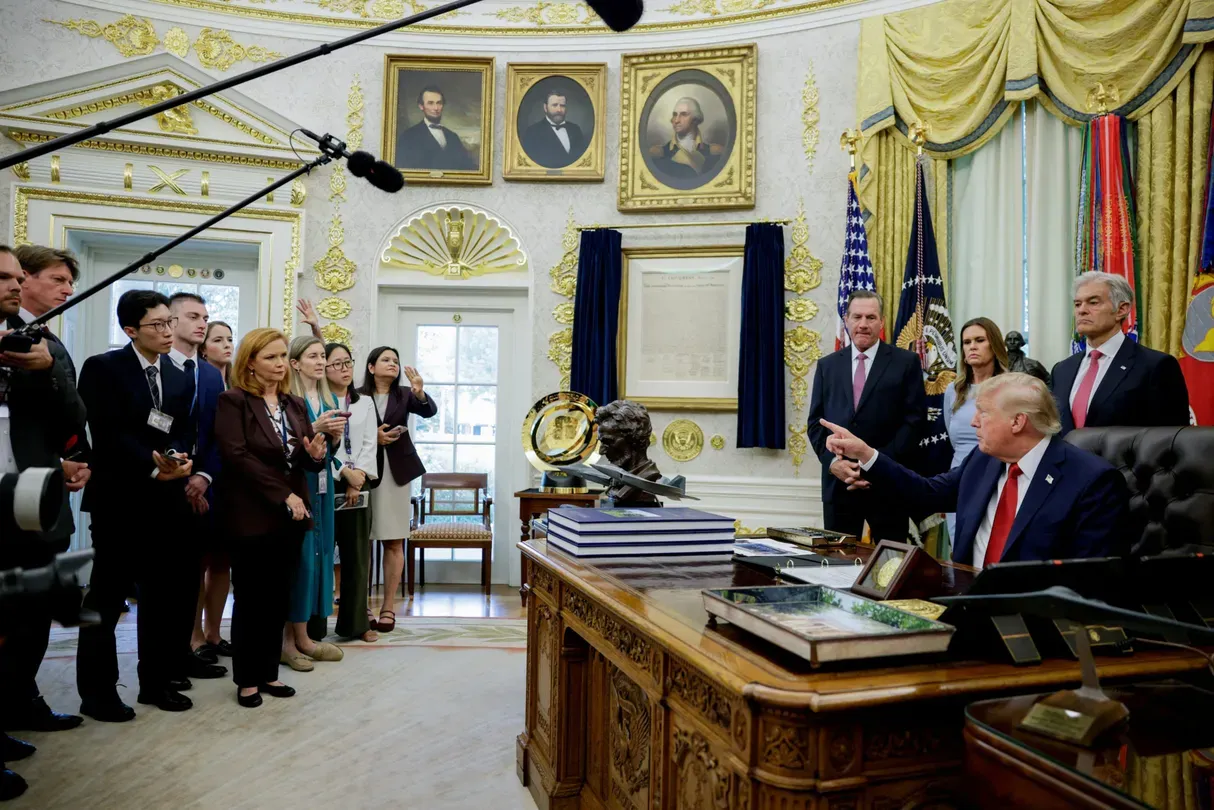
GEOFF BENNETT: Well, President Trump today also announced he's banning three major news outlets, CNN, MS NOW, and Politico, from the White House, accusing them of reporting what he calls fake news.
In a social media post, the president said - - quote -- "Media outlets shouldn't be able to constantly write or report fiction and lies."
And he suggested other news organizations could face similar action.
Later in the Oval Office today, Mr.
Trump said this: DONALD TRUMP, President of the United States: They purposely write negative news.
And they do that because they want to try and diminish the Republicans and a Republican administration.
GEOFF BENNETT: Our White House correspondent, Liz Landers, joins us now.
Liz, it's great to see you.
So, what did the president say to justify this action?
LIZ LANDERS: Well, the president admitted today that there was no particular reason why this happened today.
He, of course, has gripes with the press almost all the time.
He makes that very clear when he speaks publicly and also in social media posts.
But he, as you mentioned, says that these news outlets write negative news, though he did not specifically say which news stories he is talking about.
This is another troubling escalation from a president that has attacked the First Amendment and the free press in his first administration and now in his second one.
During his first administration, he banned particular reporters, but not entire news outlets, like we're seeing today.
This term, the Associated Press has been removed from the press pool, which PBS is a part of, and the White House has taken over the pool rotation.
The president was asked in the Oval Office today in the afternoon when those badges were being pulled.
We as White House reporters have badges that we wear.
He said he didn't know, but he wants the ban to go as far as it can.
He says that other outlets may be added to this list, Geoff.
GEOFF BENNETT: And how are the outlets themselves responding to all of this?
LIZ LANDERS: CNN is still reporting from the White House, and they have also released a statement from CNN P.R.
saying that they stand by their fair and accurate reporting, and they add that if this ban goes into effect, it will be "an illegal assault on constitutionally protected right to free speech."
Politico said that their outlet will continue to defend their First Amendment rights against any attempt to restrict them.
Leading press freedom groups are also reacting to this.
The Freedom of the Press Foundation said in a statement -- quote -- "It's difficult to imagine a more blatant violation of the First Amendment than Trump banning news outlets from the people's house for criticizing the government.
It's also hard to imagine a dumber move."
And, Geoff, former Republican White House Press Secretary Ari Fleischer took to X to say that banning certain news outlets is not the solution to this.
He said, instead, try to win the argument with reporters.
So we are seeing Republicans push back on this as well.
GEOFF BENNETT: OK, Liz Landers, thanks, as always.
LIZ LANDERS: Of course.
GEOFF BENNETT: Also during that Oval Office event today, President Donald Trump announced that all 50 states will participate in a new Medicaid drug pricing program aimed at reducing the cost of some prescription drugs.
The program requires more than two dozen participating drugmakers to offer Medicaid prices comparable to those paid in certain other countries.
But many details of the arrangement remain unclear, raising questions about the true savings.
California Governor Gavin Newsom signed an executive order today that aims to speed up safety measures for artificial intelligence, including a possible kill switch for advanced AI models.
The order follows warnings from leading tech executives and researchers that the technology is advancing too rapidly.
Newsom, a possible 2028 presidential contender, says federal officials haven't done enough to regulate the industry.
President Trump has dismissed calls for U.S.
companies to slow down their AI development.
The lone holdout juror in the Lindsay Clancy trial says he had no doubts about her guilt.
In his first public comments, Michael Desronvil said through his lawyer that based on the evidence - - quote -- "I thought it was enough proof that she knew exactly what she was doing and planned."
That contradicts the jury foreperson, who has said that Desronvil expressed doubts about Clancy's guilt, but wanted to convict her anyway.
The judge in the case declared a mistrial earlier this month.
Prosecutors must now decide whether to retry Clancy in the 2023 killings of her three children.
Russians are voting in the country's first parliamentary election since its invasion of Ukraine in 2022.
The Kremlin's United Russia Party is widely expected to retain its dominance, as it faces virtually no opposition at the polls.
Russian President Vladimir Putin is seeking to cast the election as a show of support for the war.
Meantime, in Ukraine, firefighters battled flames after a Russian drone struck this shopping mall in Zaporizhzhia.
Local authorities say one person was injured.
Also today, French President Emmanuel Macron is calling for increased protections for critical European infrastructure amid a rise in Russia's alleged drone and cyberattacks.
EMMANUEL MACRON, French President (through translator): Drone intrusions into the airspace of several countries show us that no one is safe.
So, in the face of this, we act.
The intention behind it is to intimidate us and to derail the effort to support the Ukrainians.
The consequence will be the opposite.
GEOFF BENNETT: Macron also said he would convene a G7 meeting in the coming weeks to address the ongoing energy crisis brought on by the Ukraine war and events in the Middle East.
Iran says it struck a tanker that made what officials called an illegal attempt to pass through the Strait of Hormuz.
The attack has not been independently verified.
Meantime, in Iran, hundreds of thousands of people filled the streets of Tehran for a government-sponsored display of national support and unity.
It was the largest such rally since the war started back in February, while, in Yemen, thousands rallied in support of the Iran-backed Houthi rebels and to protest Saudi accusations that the group had targeted the city of Mecca, which the Houthis have denied.
Billionaire investor and philanthropist Warren Buffett is stepping down as chairman of Berkshire Hathaway after leading the trillion-dollar conglomerate for more than 60 years.
In a letter to shareholders, the 96-year-old Buffett acknowledged that age was a factor in his decision, writing: "Father time always wins.
He has, however, given me the opportunity to see Berkshire reach a point where I am more confident than ever about what lies ahead."
Buffett becomes chairman emeritus effective immediately.
And his son Howard will now lead the company as part of a long-planned transition.
Well, on Wall Street today, stocks ended mixed after an uneasy week of trading.
The Dow Jones industrial average lost nearly 100 points.
The Nasdaq rose about 100 points.
The S&P 500 also ended the week with a small gain.
And singer-songwriter Duncan Sheik has died.
As a reluctant pop music heartthrob, Sheik was behind one of the biggest hits of the 1990s.
GEOFF BENNETT: His song "Barely Breathing" spent more than a year on the Billboard Top 100.
But Sheik bristled at the pop label and found a new audience and massive success on Broadway, writing the music for the groundbreaking show "Spring Awakening."
That musical won eight Tony Awards and a Grammy.
A post on his Instagram page says Duncan Sheik died last night, adding: "His musical legacy will continue to inspire generations to come."
The cause of death was cardiac arrest.
Duncan Sheik was 56 years old.
Still to come on the "News Hour": the case for and against the nuclear technology deal the Trump administration made with Saudi Arabia; why Democrats see a possible opening in the Texas Senate race; and Jonathan Capehart and Ramesh Ponnuru weigh in on the week's news.
Less than a year ago, aggressive immigration raids in Democratic-led cities were drawing national headlines and sparking protests across the country.
But in recent months, the Trump administration has shifted its approach.
Instead of relying as heavily on high-profile enforcement operations, federal immigration authorities are increasingly working with state and local police, especially in Republican-led states.
And the result is what some immigration advocates have called a shadow surge, a quieter form of enforcement that has helped drive ICE arrests to record levels, often with far less public attention.
To help us understand what's happening, we're joined now by Lauren Villagran, a reporter with The Marshall Project.
She was part of a team that analyzed ICE data obtained by the Deportation Data Project at U.C.
Berkeley and UCLA.
Thanks for being with us.
LAUREN VILLAGRAN, The Marshall Project: Thanks for having me.
GEOFF BENNETT: So, not long ago, immigration enforcement was highly visible.
There were those major operations in Minneapolis and in Chicago.
Now arrests are rising, but the approach is less conspicuous.
What changed?
LAUREN VILLAGRAN: Yes, I mean, I think for many Americans, the mass deportation campaign of President Donald Trump has largely faded into the background without these sort of in-your-face operations that we saw earlier this year in Chicago, Minneapolis, Los Angeles, et cetera.
But the reality is that, even though you're seeing fewer headlines, the number of immigration arrests has risen dramatically across the country.
Especially over the summer, we saw a massive uptick in arrests and the highest level ever in August.
GEOFF BENNETT: So where are these arrests increasing, and why?
LAUREN VILLAGRAN: Yes, so, this year, we've seen immigration arrests more than double in 15 states and Washington, D.C.
I mean, there are the usual suspects like Texas and Florida, which have long been top enforcers for the Trump administration's mass deportation program.
But we're also seeing pretty dramatic increases in communities across the country.
Geoff, one of the things we have seen is more than 2,000 agreements between state and local law enforcement to conduct immigration stops.
GEOFF BENNETT: And what does that look like in practice, these agreements with these state and local law enforcement agencies that have now a hand in immigration enforcement?
LAUREN VILLAGRAN: Yes, so it looks different in different states.
For example, in Republican-led Florida, you have got the Florida State Highway Patrol conducting immigration stops and handing thousands of immigrants stopped for minor traffic violations over to ICE.
And then you have got enforcement like we see in Butler County, Ohio, where a single sheriff's department has 44 deputies trained and deputized to conduct ICE-style arrests and hand immigrants over to ICE.
You know, that's a quarter of the force in this particular town.
States like Ohio and Missouri don't represent a majority of the arrests, but you have seen a really dramatic increase.
Ohio, at the end of the Biden administration, had just 20 of these agreements with the federal government to conduct immigration stops.
Today, they have 20.
In Missouri, that number is 130.
So the enforcement has been less covered by the national media, in part because it's happening on the backs of state and local law enforcement.
It's hard to know when it's a traffic stop and when it's an immigration stop.
GEOFF BENNETT: And that's by design?
The administration wanted the same results without the level of public confrontation and public attention.
LAUREN VILLAGRAN: So you saw President Trump fire Border Patrol commander at large Greg Bovino earlier this year, as well as Department of Homeland Security Secretary Kristi Noem.
When the new homeland security secretary, Markwayne Mullin, came in, he promised results without the headlines.
And that's what we have seen over the past six months.
So, while many Americans may not be paying as much attention, given the enforcement style, immigrant communities are feeling it.
GEOFF BENNETT: There's also the question, Lauren, of who is being arrested.
The administration makes the case that these deportees, that these detainees have criminal records.
What does the data actually show?
LAUREN VILLAGRAN: Right.
We keep hearing that phrase the worst of the worst.
The reality is -- and this data has been pretty consistent over the past year -- that, in a snapshot in July, when there were more than 65,000 people detained, 70 percent had no criminal conviction.
GEOFF BENNETT: And while we have you, Lauren, late this afternoon, federal appeals court rejected the president's third-country deportation policy.
Quickly, remind us what that is.
This will certainly be appealed, but bring us up to speed.
So this isn't just a Trump administration thing.
We'd seen this previously in past administrations, where the executive branch would strike an agreement with a so-called third country, when, for example, nationals of countries where it's hard to deport people like China or Cuba or Venezuela, they would potentially send those detainees to another country like Mexico or Ecuador.
The difference now is that the Trump administration has struck dozens of these deals and sent nearly 30,000 people to a country that isn't the country they came from.
That's according to Human Rights First.
GEOFF BENNETT: Lauren Villagran, reporter with The Marshall Project, thanks again for your time this evening.
LAUREN VILLAGRAN: Thank you.
GEOFF BENNETT: This week, congressional Democrats introduced resolutions aimed at blocking the Trump administration's new civilian nuclear agreement with Saudi Arabia, while a bipartisan group of senators called on the administration to declassify key details of the deal.
The agreement would open the door for the U.S.
to help Saudi Arabia develop a civilian nuclear power program, but critics say it lacks key safeguards that could restrict Saudi Arabia's ability to eventually pursue a nuclear weapon.
Nick Schifrin is back with more.
NICK SCHIFRIN: Saudi Arabia is the world's largest oil exporter, but in its effort to diversify away from fossil fuels has long wanted nuclear power.
The U.S.
and the kingdom began discussing a civil nuclear agreement more than a decade ago.
And, last month, Energy Secretary Chris Wright and Saudi Energy Minister Abdulaziz bin Salman signed what's commonly referred to as a 1-2-3 agreement.
The U.S.
will help Saudi Arabia build nuclear power plants and provide the kingdom nuclear fuel only through companies that the U.S.
and the kingdom select.
The U.S.
and Saudi Arabia will conduct a study of the -- quote -- "economic viability" of Saudi Arabia enriching uranium domestically to fuel their own plants.
That's a change from a recent agreement with United Arab Emirates, which prohibited domestic enrichment, and that's referred to as the gold standard.
And Saudi Arabia submits to nuclear inspections, but is not required to sign the U.N.
nuclear agency's additional protocol of verification measures.
The agreement now sits with Congress, which can try to block the deal with a joint resolution of disapproval.
One of the congressmen who has introduced that resolution is California Democrat Brad Sherman, a member of the House Foreign Affairs Committee.
And to debate him, we're also joined by Dan Poneman, deputy secretary of energy during the Obama administration, who was later president and CEO of Centrus Energy Corp., which produces fuel for nuclear power plants.
He's now a distinguished fellow at the Atlantic Council.
Thanks very much, both of you.
Welcome to the "News Hour."
Representative Sherman, let me start with you.
Why have you introduced legislation this week to try and stop this deal from going forward?
REP.
BRAD SHERMAN (D-CA): The Saudis want a green light to move forward with the nuclear weapons program.
MBS has made it plain that he wants to have the option of having a nuclear weapon.
The vast majority of the hijackers on 9/11 came from Saudi Arabia, and that element of politics is still there in Saudi Arabia.
We don't know whether it will be the royal family in control five or 10 years from now.
The only reason he wants this is, he wants a green light to go forward with a nuclear power program that barely conceals a nuclear weapons program.
He doesn't dare do this without an agreement with the United States.
And this is a very woefully inadequate agreement.
NICK SCHIFRIN: So, Dan Poneman, we're going to go through a few of the arguments here.
What Representative Sherman is raising is concern about Mohammed bin Salman himself, the crown prince of Saudi Arabia, a comment that he made in 2018 back on "60 Minutes."
NORAH O'DONNELL, "60 Minutes": Does Saudi Arabia need nuclear weapons to counter Iran?
MOHAMMED BIN SALMAN, Saudi Arabian Crown Prince (through translator): Saudi Arabia does not want to acquire any nuclear bombs.
But without a doubt, if Iran developed a nuclear bomb, we will follow suit as soon as possible.
NICK SCHIFRIN: So, Dan Poneman, take this argument on first.
Should the United States trust Mohammed bin Salman, given what he just said?
DANIEL PONEMAN, Former U.S.
Deputy Secretary of Energy: I think you have to distinguish, Nick, between nuclear weapons programs and nuclear energy programs.
They don't always intersect.
So what this program would do would be to provide more transparency into the Saudi nuclear energy program.
They pledge to be transparent.
They have signed up in this so-called 1-2-3 agreement to all of the onerous conditions that U.S.
law since the 19 -- 1978 Nonproliferation Act, no explosive, prior consent to enrichment reprocessing, retransfer rights, all of that, plus a bilateral safeguards agreement that Director-General Rafael Grossi of the International Atomic Energy Agency has said is very, very similar to the additional protections of the additional protocol.
I think it's clear that, if the United States does not do this deal, the deal is going to go to somebody else, and whoever it's going to be, be it Russia or China or somebody else, will not have nearly the level of transparency and protection against the weapons proliferation that we're all concerned about.
NICK SCHIFRIN: So, Congressman Sherman, let us go through some of the arguments that Dan Poneman just made.
Let's focus in on verification.
As I said at the top, right, Saudi Arabia is not submitting to the U.N.
nuclear agency's additional protocol.
That's a list of requirements that essentially allows the U.N.
nuclear agency to go wherever it wants whenever it wants.
Is -- how much of a concern is that, even if the U.S.
and Saudi have their own verifications inspections agreement?
REP.
BRAD SHERMAN: When they want to hide it, you know it's not good.
And the agreement with the United States allows us only to look at declared sites.
Their nuclear program will be at undeclared sites.
What they're asking to do is have far less inspections than was called for by the Iran nuclear deal.
And we know that that deal is totally unacceptable to Donald Trump.
But when you buy -- when you do a $10 billion deal with Trump in real estate, when Kushner gets $2 billion for his fund, all of a sudden, Trump is just fine with having a nuclear program in a Middle East state.
We should know that, when they say they don't want inspections, there's a reason.
NICK SCHIFRIN: Dan Poneman, take that on.
The language from the U.S.-Saudi agreement does allow for short-notice access to the agency during regular working hours.
So is your argument that that's just simply strong enough and the best we can get if Saudi Arabia won't sign the U.N.
nuclear agency's version?
DANIEL PONEMAN: My argument, Nick, is that the deal provides for exclusivity.
So the United States will be the exclusive partner.
Anything that they do under that agreement is supposed to be at a covered site, and the U.S.
has robust inspection rights, which are not implemented by the United States, but by International Atomic Energy Agency inspectors.
Anything that were covert that Saudi were to do elsewhere would be a violation of their full scope safeguards agreement with the International Atomic Energy Agency and could be subject to a request by the International Atomic Energy Agency for a special inspection.
NICK SCHIFRIN: Congressman Sherman, let me now focus on the concerns about enrichment that you and others have had.
We have been talking about verification.
Let's talk about enrichment.
This deal allows for the possibility that, after a two-year study, Saudi Arabia would be allowed to enrich domestically.
Why does that particular part of this deal concern you?
REP.
BRAD SHERMAN: Well, first, they will need permission from the United States, but only from the president, in order to go forward with enrichment.
Saudi Arabia was the home to the vast majority of 9/11 hijackers.
We don't know who's going to be running Saudi Arabia in the future.
We do know that the guy who's running it now wants a nuclear weapon.
NICK SCHIFRIN: Dan Poneman, do you have faith that the United States could have what some people in the Biden administration designed as a kind of black box, that they would be able to control enrichment, make sure it was by Americans, even if it was in Saudi Arabia?
DANIEL PONEMAN: I actually do, Nick.
And that mean would mean that Saudi Arabia would have no access to the technology.
It would be, as the name implies, excluded from their access.
NICK SCHIFRIN: Congressman, bottom line, do you think you can block this?
REP.
BRAD SHERMAN: We can block it only if we get the support of the American people.
It is true that, under this -- if Saudi Arabia complies with this agreement, they're not allowed to develop a nuclear weapon.
But, then again, North Korea promised to never develop a nuclear weapon.
Iran promised.
And a mere promise that's easy to cheat on is not in America's interest.
DANIEL PONEMAN: The deal that has been struck by the United States government with the Saudi Arabians is the strongest nonproliferation deal that you are going to get, and that it is deeply in the U.S.
long-term strategic interest that they partner with us and not with China or Russia or anyone else.
You start with what's good and you keep trying to build us something better.
I think the U.S.
is the partner of choice purely on nonproliferation grounds.
NICK SCHIFRIN: Dan Poneman, Congressman Brad Sherman, thank you very much to you both.
REP.
BRAD SHERMAN: Thank you.
DANIEL PONEMAN: Thank you, Nick.
GEOFF BENNETT: Texas has been reliably Republican for three decades, despite repeated Democratic hopes that shifting demographics might change its politics.
But, this year, Republican divisions, political scandals, rising prices, and local fights over big tech are giving Democrats new hope of an upset in the U.S.
Senate race there.
Our Liz Landers was in Texas earlier this week and has this report.
LIZ LANDERS: In deep red rural Texas, Cheryl Shadden and her dogs round up the horses.
She's a lifelong Republican and has lived in Hood County for decades, but over the last few years, a new neighbor has dramatically changed her life and her political allegiances.
CHERYL SHADDEN, Texas Voter: It's become unbearable living here.
LIZ LANDERS: Across the street, a new data center.
She says it's constant noise is costing her sleep, her health, and her property value.
CHERYL SHADDEN: I wake up in the morning and my ears buzz and ring.
I have lost hearing because of this.
I have got permanent conductive hearing loss.
We have health problems.
We don't sleep.
LIZ LANDERS: Uproar over data centers has become a national flash point, with Republicans and Democrats still figuring out how to handle the issue.
CHERYL SHADDEN: Typically, what it sounds like is Niagara Falls.
LIZ LANDERS: It's having a direct impact now on Shadden's vote in the high-profile race for U.S.
Senate, leading her to break from her party.
KEN PAXTON (R), Texas Senatorial Candidate: I think it's a good idea to slow this down so that we can listen to our to our constituents.
LIZ LANDERS: In late August, U.S.
Senate candidate and current state Attorney General Ken Paxton called for repealing a tax break that spurred data center growth in Texas.
Shadden says that's not good enough.
CHERYL SHADDEN: Where have you been the last three years?
Not here with us.
So, in our mind, unless you do something meaningful before November, you won't get our vote.
LIZ LANDERS: Data centers aren't Republicans' only electoral problem.
Gas prices are higher than usual.
Diesel is off the charts, driven by a foreign war extending into its seventh month and opposed by many conservatives.
And then there's Paxton himself.
CHERYL SHADDEN: He's seeming kind of dirty right now, like a career politician that could possibly be a used car salesman.
ANNOUNCER: Ken Paxton.
LIZ LANDERS: His bruising primary win over incumbent Senator John Cornyn split the party.
Trump backed Paxton, while Cornyn warned Paxton's history of scandal could put the safe seat at risk.
He spent nearly nine years under indictment for securities fraud before a deal got the charges dropped.
The Texas House impeached him in 2023, mostly over abuse of power allegations.
The state Senate acquitted him.
And last year, his wife filed for divorce, citing adultery.
Paxton denies wrongdoing.
Mr.
Paxton, Liz Landers with "PBS News Hour."
Paxton didn't take our questions, but did speak with FOX News' Bret Baier.
KEN PAXTON: Well, look, Bret, when you're fighting, they come after you.
Look at Donald Trump.
He had many more indictments than I did.
He had two impeachments.
I went through a very similar process as him.
When you go after things that protect the people of your state, they come after you, and none of those things were proven.
LIZ LANDERS: Democrats haven't won statewide in Texas in more than 30 years, but this year they see an opening thanks to the local, state, and national political landscapes, as well as a strong candidate.
STATE REP.
JAMES TALARICO (D-TX), Senatorial Candidate: In red areas and blue areas alike, everyone is struggling.
LIZ LANDERS: Democrat James Talarico is a state representative and seminarian, running as a moderate, guided by his Christian faith.
STATE REP.
JAMES TALARICO: We are building a movement to take back our state and take back our country.
STATE REP.
JAMES TALARICO: We are uniting Texans onto one team to take on this broken, corrupt political system.
LIZ LANDERS: He's focused on issues like raising the federal minimum wage to $15, raising taxes on billionaires, and passing comprehensive immigration reform.
And Talarico wants to give local officials approval power over new data centers.
While Republicans met for a midterm convention in Dallas, his campaign rolled out 21 current and former Republican officials backing him.
STATE REP.
JAMES TALARICO: God is both masculine and feminine and everything in between.
God is nonbinary.
LIZ LANDERS: But his critics have forced him to walk back past controversial comments on social issues.
QUESTION: God is nonbinary.
Do you still stand by that?
STATE REP.
JAMES TALARICO: I was being provocative with that statement.
I get that.
What I was trying to say is that you can't use human categories to define God.
And that's not controversial theologically.
LIZ LANDERS: The president's backing proved instrumental in Paxton's primary.
Trump used the convention spotlight to argue he can be again this November, even with his approval rating underwater.
DONALD TRUMP, President of the United States: I'm asking you to pretend that I'm on the ballot.
LIZ LANDERS: Trump's just begun fulfilling his promise to financially float Paxton's campaign, his super PAC, MAGA Inc., buying $10 million worth of ads on Paxton's behalf.
NARRATOR: Paxton's plan?
Doubling the child tax credit, big write-offs for medical expenses, and a $50,000 deduction for first-time homebuyers.
LIZ LANDERS: That prompted additional cash and ads from other Republican groups, effectively erasing Talarico's sizable cash advantage.
Back at the convention, suburban Dallas Republicans told us they will back their nominee.
Not all of them are sure he can win.
FRANK HOLOMSHEK, Texas Voter: Not sure Paxton's the right guy, but he's the right guy this time.
CHRIS DANIEL, Texas Voter: What I say to a Republican who's either thinking of not voting or voting for Talarico is, the alternative is worse.
For all the things that you don't like about Ken Paxton, and there can be many, and -- it will be far worse.
LIZ LANDERS: Cheryl Shadden expects a lot of Republicans to skip the Senate race, rather than back a Democrat they see as too far left.
CHERYL SHADDEN: As far as Paxton goes, I will most likely not vote for Paxton.
A lot of Republicans are just not going to vote for that slot because they feel like Talarico is too far left.
In my mind, how I look at it is, we have seen what has happened to my community for the last three years.
So why would we vote for these same people again?
LIZ LANDERS: How many Texas Republicans stay home, skip the race, or cross over will likely decide whether their party's 30-year streak survives?
For the "PBS News Hour," I'm Liz Landers in Granbury, Texas.
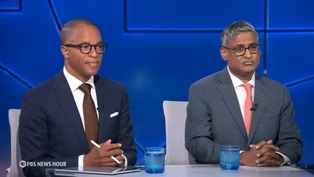
GEOFF BENNETT: Now to discuss Republicans' frustration with their own party ahead of the midterms and how Congress is responding to warnings about artificial intelligence, or not, we turn to the analysis of Capehart and Ponnuru.
That's Jonathan Capehart of MS NOW and Ramesh Ponnuru, editor of The National Review.
David Brooks is away this evening.
Good evening.
gentlemen.
JONATHAN CAPEHART: Hi, Geoff.
RAMESH PONNURU, Editor, "The National Review": Good evening.
GEOFF BENNETT: Before we get to these other issues, I want to start with this announcement tonight from President Trump that he is banning MS NOW, CNN, and Politico from the White House because he doesn't like what those outlets report.
Jonathan of MS NOW, we will start with you.
Your reaction.
JONATHAN CAPEHART: Look, this is not a story about us at MS NOW.
It's not a story about CNN.
It's not a story about Politico.
It is a story about a president of the United States who is continuing to squeeze freedom of the press.
We are not the first ones to be targeted by him, the AP, ABC News, other news outlets.
Our job, no matter where we are, no matter where we sit, is to report the news, report it in real time, and to hold power accountable.
And we're going to do that, whether the president of the United States likes it or not.
And we're going to do it from wherever, wherever it's -- if it's at the White House or not at the White House.
And I will say, at this moment, at last I checked, we're still there.
GEOFF BENNETT: And, Ramesh, President Trump is not the first American president to not enjoy critical press coverage.
RAMESH PONNURU: That's right.
Trump, though, is a marked change from previous presidents.
He has now a long record of making comments that are hostile to the freedom of the press, talking about pulling broadcast licenses from stations that air what he regards as fiction.
And I think that's the nub of the issue.
You can have your own opinion about what's true, what's false, what's fair, and what's unfair, but the whole point of a First Amendment is the government does not get to officially decide what's true and what's false.
GEOFF BENNETT: I want to shift our focus to something we saw this past week from the Florida Republican Congresswoman Maria Salazar.
She shot this ad that's up on the airwaves now in Florida just weeks ahead of the midterms breaking with the Trump administration over his immigration agenda.
Take a look at this ad.
REP.
MARIA ELVIRA SALAZAR (R-FL): Mr.
President, some of your immigration enforcement efforts have gone too far.
In July, 50 percent of the 50,000 people that were detained had no criminal record.
The same Hispanics who helped you get to the White House in 2024 feel betrayed today.
GEOFF BENNETT: She recorded that ad in front of the White House, a not-so-subtle message there.
So, Jonathan, what does it mean that a Republican like Maria Salazar, a district that Trump won by 15 points, is up with an ad like this?
JONATHAN CAPEHART: It's the clearest signal, to me anyway, that Republicans are in trouble with their House majority, that Republicans are in trouble with Latino voters.
I mean, Congresswoman Salazar is right.
I mean, President Trump won the biggest share of Latino voters since President Bush.
I can't remember it was his first election or the second.
(CROSSTALK) JONATHAN CAPEHART: Yes, in the second election.
And so I remember at the convention, where she -- you and Amna tried to interview her over the din and talking to her about the president, the first assassination attempt, and she vowed right then and there, he's a changed person.
He is going to be different from the way he was before.
And what we have seen since is that nothing's changed.
He's the same, if not worse than the first Trump administration.
The key word she used in that ad, and I'm glad you played it, was betrayed.
And I had not seen the ad.
I only read the stories when it focused on it earlier.
And I thought about David Brooks months ago when he talked about how Trump voters must feel betrayed by the president because he promised all these things and he has not fulfilled them.
And for her to use that word, and for her specifically in a district that she won her seat the last time by 20-something points, he won her district comfortably, for her to come out in this way direct to camera, to your point, from the White House, should be a signal to Republicans in general and to the president in particular that they are in trouble.
GEOFF BENNETT: And, Ramesh, as Jonathan mentioned we interviewed her at the RNC, the convention.
Amna interviewed her more recently and pressed her on the potential for mass deportations because it was known then that there weren't enough undocumented immigrants with criminal records to reach the deportation numbers that the administration was calling for.
So here's part of that interview.
REP.
MARIA ELVIRA SALAZAR: That deportation is going to be among those criminals who are the gang members, the got-aways, the Tren de Aragua.
I am sure -- and I'm going to be the number one... AMNA NAWAZ: Not all 200,000 undocumented in your community, is that what you're saying?
REP.
MARIA ELVIRA SALAZAR: I am sure that we're not, that the Trump administration is not going to be targeting those people who have been here for more than five years, that have American kids, that don't have criminal records, that have been working in the economy and paying taxes.
GEOFF BENNETT: So do you make of what she's saying now?
RAMESH PONNURU: Well, I don't think that she has grounds for saying that she was betrayed.
There were plenty of signs from what the president was saying on the campaign trail in 2024 and from the people he surrounded himself with that there would be, in fact, mass deportation.
I mean, that was the phrase they used constantly during the 2024 campaign.
Now, it turns out, though, that the way they have gone about implementing that policy, they have lost huge amount of support, not just among Hispanics.
Immigration was a huge, powerful, positive issue for Trump's reelection in 2024.
That advantage has now been squandered because people don't like the face of the immigration enforcement regime.
GEOFF BENNETT: I want to shift our focus now to an op-ed that Karl Rove wrote.
Of course, he's one of the architects of the modern Republican Party.
He wrote this week that he plans to vote for a Democrat in a Texas race after Republican Bo French made bigoted comments.
He writes this: "The GOP has a growing number of Bo Frenches, and not only in Texas.
Conservatism and the party it dominates have an increasing number of bigoted advocates of a heritage America composed of white descendants of the original European settlers."
And he argues that Republicans built their strength in Texas by welcoming this diverse coalition of voters who happen to share conservative values.
What does it say about the party that you have Karl Rove, who feels now compelled to draw this line?
JONATHAN CAPEHART: It says that the Republican Party is in trouble.
And, in fact, I would say that the Republican Party of Karl Rove, Mitt Romney, George W. Bush is gone.
I mean, that Republican Party put the Bo Frenches of the world over here.
They knew they were there, but they didn't let them anywhere near elected office or of any significance.
And now that's all done from the presidency on down.
And it would be helpful -- it's great that Karl Rove has come out and written this op-ed and has sent a signal.
We're talking about it because Karl Rove is not an insignificant person in American politics and the Republican Party.
But it would be great if we could have folks in higher elected office -- and that's no shade on Senator Cornyn, who said something very strong about this.
But it'd be great if, say, the president of the United States were to set the example and say, this kind of language, this kind of talk, these kinds of views are not what we are about as a party.
It's not what I am.
And since you guys follow me, you should act accordingly.
But, as we see with Bo French, they're acting accordingly.
RAMESH PONNURU: French has an extensive record of disparaging nonwhite people.
And the president has set an example.
One of the ways he has set an example is when Rove said that he wasn't going to vote for French.
Trump denounced Rove, not French.
Party loyalty matters more than the expression of these bigoted, hateful and un-American sentiments.
That's the -- that's the tone he set.
GEOFF BENNETT: Is there still a meaningful mechanism inside the Republican Party for policing conduct that prominent Republicans, they might not be MAGA Republicans, but that prominent Republicans, respected Republicans believe crosses a line?
RAMESH PONNURU: Well, Republican voters have a way of policing that, and I think we might very well see it in this election, particularly because you have got this extreme provocation from French, but he also would only be one of three railroad commissioners.
So it's kind of a low-cost way of Republicans to draw this line and say, no, we're not going to support him.
GEOFF BENNETT: Jonathan?
JONATHAN CAPEHART: Great point.
But I'm glad Karl Rove said something.
I'm glad Senator Cornyn said something.
When these situations, these instances happen, it would be great if more Republicans would come out and forcefully condemn what's being done and what's being said.
GEOFF BENNETT: Jonathan Capehart, Ramesh Ponnuru, our thanks to you both.
JONATHAN CAPEHART: Thanks, Geoff.
RAMESH PONNURU: Thank you.
GEOFF BENNETT: When the Taliban swept back into Kabul in August of 2021, thousands of Afghans who had worked alongside Americans and their families suddenly faced an uncertain and dangerous future.
Among them were four young women who had grown up in a rapidly changing Afghanistan with ambitions for college, careers and lives of their own.
Their extraordinary escape from Afghanistan and the lives they built afterward in the U.S.
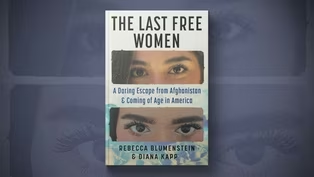
are at the heart of a new book, "The Last Free Women: A Daring Escape from Afghanistan and Coming of Age in America."
It's written by Rebecca Blumenstein, now president of editorial at NBC News, who was then a deputy managing editor at The New York Times.
Her co-author is journalist and author Diana Kapp.
I spoke with them earlier today.
Rebecca Blumenstein, Diana Kapp, welcome to the "News Hour."
DIANA KAPP: Thanks for having us.
REBECCA BLUMENSTEIN: Great to be here.
GEOFF BENNETT: Take us back to August 15, 2021.
Kabul is falling.
At the same time, you were driving your son across country to college.
How quickly did you realize that what was unfolding in Afghanistan would turn out to be a life-and-death situation for your then-Afghan colleagues?
REBECCA BLUMENSTEIN: When Kabul and Afghanistan started falling, it just happened far faster than anybody thought it would.
Of course, the U.S.
had signaled that we were pulling out.
But people thought the Afghan forces that the U.S.
trained, they would hang in at least for a while.
And province after province started falling.
They started getting closer and closer to Kabul.
We were scrambling, like many news organizations, like many vets, to do whatever we could to get our people out of Afghanistan.
It was clear at that moment that the U.S.
was going to be of no help.
And so the task to the top editors at The Times was like find them a way out of there and find a country where they can go.
And I was literally calling anyone in the world I could think of.
GEOFF BENNETT: And The New York Times ultimately evacuated 124 Afghan employees and their family members.
What did The Times have to do that the U.S.
government at the time could not or did not do?
REBECCA BLUMENSTEIN: We were able to get a request into the deputy foreign minister of Qatar and a manifest with a list, which is a list of all of the names of the employees we wanted to evacuate, their family members, their birth dates, and their documents.
And we had been pressing the U.S.
to issue visas, and they just -- it was so chaotic, it was clear that it was not going to happen for the U.S.
So we had to get foreign governments to help us.
Qatar would only take us if we found another country.
They did not want people to stay in Qatar, importantly.
And so we were able through our reporter in Mexico - - he convinced Mexico's foreign minister to take them.
And you remember the images of the thousands of people who descended on the airport in Kabul, many of them so desperate to leave, with no way out, some of them so desperate to leave that they climbed literally into the wheel holes of planes and fell to their deaths.
We had a plan.
We finally got Qatar to say they would take them out on a plane.
They couldn't land the plane.
Our group was there for two days.
They fell under attack from the Taliban and they had to try again three days later.
And, by that point, the Taliban controlled the entire city.
So we had to appeal for help, and thankfully found it in the right places through some luck.
GEOFF BENNETT: And, Diana, when you heard this story, when did you realize that this was more than just an extraordinary evacuation story, that there was a larger, deeper narrative here?
DIANA KAPP: As I write in the book, it's a hell of a story.
So, I had been talking to Rebecca, who's a close college friend, and I had been interested in Afghanistan because I went to Afghanistan in 2012, and I had the opportunity to visit a woman building schools in the far north in the Takhar province.
And it was the height of girls' education.
It was, the Americans landed in 2001.
The school doors flung open.
Girls rushed in.
There was classrooms with as many as 70 girls in them.
And we walked into a few classrooms and we asked the little girls, how many of your mothers can read or write?
And not a single hand would go up.
And then we would ask them, how many of you imagine going to university?
And they would all shoot their hand up.
So we understood, I understood that this was a generation of women that had huge aspirations for themselves, and it was washed away in an instant in a morning.
And so as soon as I heard this story and the great work The New York Times was doing, I knew it was a tale we should start to follow.
GEOFF BENNETT: And you center this book on four women, Marwa, Mursal, Maryam, and Samira.
Why these four?
What did their different lives allow you to show about a generation of Afghan women?
DIANA KAPP: They were between the ages of 17 and 24, and they were all poised, right at the cusp of launching into their adult lives, into careers that they were passionate about.
Mursal had completed law school.
Maryam was a senior in high school and headed to medical school.
And Marwa was in her fourth year of medical school when she woke up that morning to learn that, instead of returning to classes after the pandemic, she would be running for the airport.
So we chose a cohort that was of similar age and was very much of that generation that had high aspirations for themselves.
REBECCA BLUMENSTEIN: When you think about it, maybe one of the largest accomplishments of the longest war that we waged in Afghanistan was the education of the women of Afghanistan.
And we were finally fortunate enough to get this group of 124 into the U.S., and I was rather startled to hear that the typical expectations of refugees in this country are a lifetime of poverty.
And it just felt, especially for the women, especially those who were on the cusp of becoming doctors and lawyers and really wanted to build the future of Afghanistan, to lose it all in half an afternoon and to come here and to have to give it all up and have no hope of going back to school seemed wrong, and especially because of what happened, obviously, to the women of Afghanistan.
GEOFF BENNETT: And there's a question embed in the successful evacuation of the 124 Afghans.
What does it mean for the millions of Afghans who didn't have a powerful American institution advocating on their behalf?
REBECCA BLUMENSTEIN: Exactly.
Many of the people in our group struggle with a bit of guilt that they were -- they were evacuated.
And I think The Times did something very significant here.
They didn't just take out the expat foreign reporters.
They decided to take out the entire bureau, everybody who had had ties to the 20 years of the bureau in Kabul, the cooks, the gardeners, the translators, the drivers, and their immediate families.
But, obviously that's a limited number of people.
And I think those who made it out do feel a duty.
They can't do much to change the situation there, but the title of the book, "The Last Free Women," does convey the sense that, for those here, whether they're illiterate, whether they were on the cusp of becoming doctors and lawyers, they want to do whatever they can and work as hard as they can to take advantage of the freedom they have here.
GEOFF BENNETT: How do the four women you profile, how do they make sense of that and how has that shaped their lives, the fact that they were evacuated and had the opportunity to start over again in the States?
DIANA KAPP: They have jumped into their lives here with just incredible force.
Of course, there was trauma and they had a lot of challenges.
Some of them have been -- real difficulty, like how to learn to use a computer.
They had to learn to speak English.
They had cultural issues.
They went on to college campuses.
In Afghanistan, girls don't leave home and live away from home in a dorm.
It just doesn't exist.
So there was -- on so many levels, they were confronting a lot.
And yet they went after it with such, such tenacity.
The young woman Mursal, she was desperate to work at the United Nations in her internship between her two years of Cornell, where she got a master's in public administration and graduated.
But she made 30 applications to every single department she could find.
And she had each of them edited by ChatGPT.
She did all of that herself, because, even though professors told her this is extremely competitive and you won't get it, she went right ahead and tried anyway.
And you -- we just have seen that over and over again, where they just -- they just keep stepping forward.
REBECCA BLUMENSTEIN: And our women are quite different.
Samira Rustami, she grew up in a household where her mother did not support education.
Her mother actually burned her books.
And she figured out a way to get an MBA in India, leave the country, come back.
She had just been in Kabul for a couple of months.
Her husband had worked for The New York Times just for a couple of -- a couple of months as well.
They get on the manifest.
And she has come here.
She had a daughter.
They moved to Pittsburgh,.
She is about to become a nurse, and her daughter has basically been adopted by a family in Pittsburgh and now goes to the Jewish community center for kindergarten.
And you think about Durrin and the life that she will have and how different it is than even her mother's, and it's really quite astounding.
DIANA KAPP: It's so striking watching these women.
They don't just work hard and do the schoolwork.
They also find the joy in life.
So they want to learn how to do scuba diving.
They have tried -- on her 30th birthday, Mursal bought an inflatable paddleboard and took it out on the Potomac River.
She's learned to swim.
They take yoga.
They're trying ceramics.
They want to learn to play the piano.
So they are embracing life in so many different ways.
GEOFF BENNETT: Tremendous stories and a terrific new book, "The Last Free Women: A Daring Escape from Afghanistan and Coming of Age in America."
Rebecca Blumenstein, Diana Kapp, thank you so much for being here.
REBECCA BLUMENSTEIN: Thanks for having us.
DIANA KAPP: Thank you.
Thank you, Geoffrey.
GEOFF BENNETT: Be sure to tune in to "Washington Week With The Atlantic" tonight right here on PBS.
Our own Liz Landers moderates a discussion about President Trump's response to AI concerns and his upcoming state visit with China's president.
And watch "Horizons" this weekend.
Guest host Ali Rogin and her panel explore grief and the complexities of losing a loved one.
And, on "Compass Points," Nick Schifrin speaks with correspondent Reza Sayah about what's happening inside Iran.
You can watch both "Horizons" and "Compass Points" on our YouTube channel or wherever you get your podcasts, and, of course, on your local PBS station.
Well, that is the "News Hour" for tonight and this week.
I'm Geoff Bennett.
For all of us here at the "News Hour," thanks for spending part of your evening with us.
Have a great weekend.
Capehart and Ponnuru on Trump's attacks on press freedom
Video has Closed Captions
Capehart and Ponnuru on Trump's attacks on press freedom (9m 32s)

'Shadow surge' pushes immigration arrests to record highs
Video has Closed Captions
'Shadow surge' pushes immigration arrests to highs as Trump administration shifts tactics (5m 45s)
'The Last Free Women' follows Afghans rebuilding their lives
Video has Closed Captions
'The Last Free Women' follows 4 Afghans rebuilding their lives after escaping the Taliban (9m 57s)
Trump bans news outlets in latest attack on press freedom
Video has Closed Captions
Trump says he's banning 3 outlets from White House in his latest attack on press freedom (2m 48s)
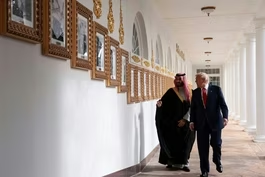
U.S.-Saudi nuclear deal faces pushback over weapons risks
Video has Closed Captions
U.S.-Saudi nuclear power deal faces pushback over potential weapons risks (8m 46s)
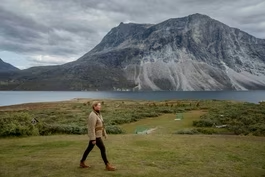
What's in the Greenland agreement between U.S. and Denmark
Video has Closed Captions
What's in the Greenland agreement between U.S. and Denmark (2m 49s)
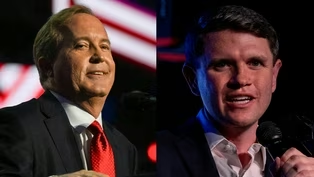
What's making the Texas Senate race so competitive
Video has Closed Captions
What's making the Texas Senate race so competitive (6m 23s)
Providing Support for PBS.org
Learn Moreabout PBS online sponsorship New Episode
- News and Public Affairs

FRONTLINE is investigative journalism that questions, explains and changes our world.
 New Episode
- News and Public Affairs

Today's top journalists discuss Washington's current political events and public affairs.

 New Episode
 New Episode
 New Episode
 New Episode
 New Episode


 New Episode
Support for PBS provided by:
Major corporate funding for the PBS News Hour is provided by BDO, BNSF, Consumer Cellular, American Cruise Lines, and Raymond James. Funding for the PBS NewsHour Weekend is provided by...