
Washington Week with The Atlantic full episode, 12/4/25
12/5/2025 | 24m 9sVideo has Closed Captions
Washington Week with The Atlantic full episode, 12/4/25
Washington Week with The Atlantic full episode, 12/4/25
Problems playing video? | Closed Captioning Feedback
Problems playing video? | Closed Captioning Feedback
Major funding for “Washington Week with The Atlantic” is provided by Consumer Cellular, Otsuka, Kaiser Permanente, the Yuen Foundation, and the Corporation for Public Broadcasting.
Washington Week with The Atlantic full episode, 12/4/25
12/5/2025 | 24m 9sVideo has Closed Captions
Washington Week with The Atlantic full episode, 12/4/25
Problems playing video? | Closed Captioning Feedback
How to Watch Washington Week with The Atlantic
Washington Week with The Atlantic is available to stream on pbs.org and the free PBS App, available on iPhone, Apple TV, Android TV, Android smartphones, Amazon Fire TV, Amazon Fire Tablet, Roku, Samsung Smart TV, and Vizio.
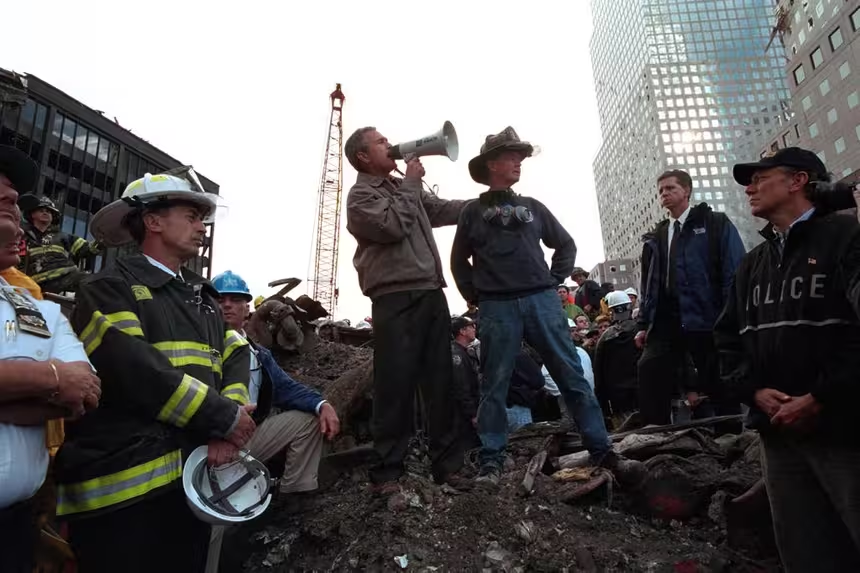
10 big stories Washington Week covered
Washington Week came on the air February 23, 1967. In the 50 years that followed, we covered a lot of history-making events. Read up on 10 of the biggest stories Washington Week covered in its first 50 years.Providing Support for PBS.org
Learn Moreabout PBS online sponsorshipJEFFREY GOLDBERG: The Trump administration's self-styled secretary of war, Pete Hegseth, has spent most of the week on defense, facing accusations that he committed war crimes and that he endangered the lives of U.S.
pilots.
At the Pentagon, it seems to be all turmoil all the time, next.
Good evening and welcome to Washington Week.
On Thursday, the acting inspector general of the Department of Defense released his report on Signal Gate in which top national security leaders discuss secret military information on a commercial messaging app with, not to put too fine a point on it here, me.
The inspector general found that Defense Secretary Hegseth's behavior endangered the safety of American pilots and that he should not have been using a commercial messaging app or his own phone to share secret information about upcoming airstrikes.
In response, Hegseth and his spokesman, Sean Parnell, denied that the report said what it said.
This is what Parnell wrote.
The inspector general review is a total exoneration of Secretary Hegseth and proves what we knew all along, no classified information was shared.
This matter is resolved and the case is closed.
Hegseth himself tweeted, total exoneration case closed.
Here is what the inspector general actually wrote.
The secretary's transmission of non-public operational information over Signal to an unclear journalist, that would be me, and others two to four hours before plan strikes using his personal cell phone exposed sensitive DOD information.
The secretary's actions created a risk to operational security that could have resulted in failed U.S mission objectives and potential harm to U.S.
pilots.
Hegseth, Parnell and other administration officials are claiming that these findings represent a total exoneration.
Let me be blunt here.
These people think we are idiots.
I try not to express my personal views from this chair, but since Signal Gate happened on my phone, let me say that the most disturbing aspect of this whole episode is that if any other official at the Department of Defense and certainly any uniform military officer shared information 1 in 100th as sensitive as Hegseth and others shared on an insecure messaging app, without even knowing that the editor-in-chief of The Atlantic was on the chat, they would be fired or court-martialed for their incompetence.
That's what I have to say about that.
To find out what others have to say about this and about the growing controversy regarding Hegesth's use of the military to fight alleged drug traffickers in the Caribbean, let me bring in three experts, Peter Baker, the chief White House correspondent at The New York Times, Susan Glasser is a staff writer at The New Yorker, Nancy Youssef is a national security correspondent at The Atlantic.
Thank you all for joining us.
So, it's been a terrible week for Pete Hegseth.
Objective reality suggests that.
We know the secretary of defense is a hard job, but, Peter, a lot of these wounds seem self-inflicted.
PETER BAKER, Chief White House Correspondent, The New York Times: Self-inflicted, and we're debating whether the secretary of defense is following the rules of war in terms of blowing up boats in the Caribbean and following the rules of security on his own phone in terms of military operations.
These are two things you don't want to hear about a secretary of defense, particularly a secretary of defense dealing with matters of life and death.
You know, dozens of people have been killed in these operations in the Caribbean.
The strikes that were at issue on the call that you happen to -- on the Signal chat, that you happen to be added to, involved dozens of people presumably who killed in the Houthi bases that they were striking at, and many of military operations who could have been in danger had the enemy known what you knew, right, and what, you know, shouldn't have been known to anybody outside of the chain of command.
And to say it wasn't classified is sort of not the point.
The fact that he decided I declassified it, well, why would you declassify information like that?
That makes no sense, right?
This information is not post facto, okay, it's time now to release that.
This is information real-time that could affect an operation.
JEFFREY GOLDBERG: You know, the interesting thing about that is that he has original declassification authority as a secretary of defense, but he didn't declassify it.
He just used it for the sake of -- SUSAN GLASSER, Staff Writer, The New Yorker: Yes, it's like the ESP defense.
It's like, you know, that he might've imagined in his head that it was declassified.
Like I don't think that's how it works when you actually are declassifying something.
So, even the fiction of this defense, which is it was declassified by virtue of the fact that I shared it, is not.
JEFFREY GOLDBERG: I use the ESP defense all the time at home, but not -- SUSAN GLASSER: Like I thought about it.
JEFFREY GOLDBERG: But not when I'm attacking the Houthis.
SUSAN GLASSER: Yes.
JEFFREY GOLDBERG: Yes.
But, Nancy, let's talk about this in detail, the I.G.
report, the inspector general report.
How did you interpret the findings?
NANCY YOUSSEF, National Security Correspondent, The Atlantic: The I.G.
concluded that while he had the authority, he didn't -- they didn't want to answer directly the question that whether it was classified properly or not.
What they did instead is spelled out all the ways you're supposed to declassify something, and noted that he didn't carry those out.
And so their conclusion was essentially that he put U.S.
service members in potential harm's way by sharing information this way.
And what they outlined without sort of saying it directly, even in the unclassified version, is that he picked up words verbatim from the U.S.
Central Command commander in the run-up to this, the first major military campaign under the Trump administration, and typed them verbatim into a Signal chat.
JEFFREY GOLDBERG: It was almost like a copy/paste -- NANCY YOUSSEF: That's right.
JEFFREY GOLDBERG: -- from a secure communication.
NANCY YOUSSEF: and let's be clear what he was typing in, times, strike targets, platforms that were going to be used.
And, to me, the most interesting thing in all of this is, while the secretary claims that not only was it not classified but that he was providing non-essential information, like the details of an operation, he was continuing to communicate with U..S Central Command, according to the report on secure comms.
So, he's typing it into Signal and calling it unclassified while talking to the commander in a secure system at the very same time.
PETER BAKER: I'll try a counterfactual here, Jeff.
Had you published that information at the time you received it on your phone?
They would've come after you, right?
JEFFREY GOLDBERG: Right.
And they also would've canceled the strike.
PETER BAKER: They would've said, this is dangerous.
This is putting our troops in danger.
We shouldn't have that -- JEFFREY GOLDBERG: Right.
A counterfactual, to be clear, that I would never obviously engage in.
But it's interesting.
This is the way you can tell if it's sensitive or not.
If I had put that on Twitter immediately, would the United States Air Force have continued or the Navy continued with the strikes?
No, because then the Houthis would know that the planes are coming and they have air defense.
PETER BAKER: Well, the president is -- sorry.
But the president is accusing members of Congress of sedition for simply stating the rules of war, but that's not a problem if you put out operational information.
SUSAN GLASSER: The whole thing is insulting to us.
I mean, I do think this goes back to the idea, like here we are months later debating, did the sun rise this morning?
I mean, you know, these facts are essentially on their face, remarkable.
We all understand and it's important that we have an inspector general.
It's important that an investigation is done.
But the bottom line is the official leadership of the Department of Defense is at war with reality here in the response.
And, you know, the question I have that's completely unanswered is what, if anything, is going to -- where is accountability for Pete Hegseth in terms of how he's running the Department of Defense?
What is Congress going to do about this?
Where is the oversight and accountability of this?
What I've seen is some statements from Republican members of Congress, including those with senior positions on Capitol Hill, basically saying like, oh, everything's fine here, move along, move along, which, again, is a remarkable -- it is an abdication of responsibility.
JEFFREY GOLDBERG: And it's not exactly oversight.
Nancy, let me ask you a question, as a Defense.
Department correspondent currently in physical exile from the Pentagon, because as we've discussed on the show in the past, you guys have basically been removed from -- you guys, meaning the entire press corps, removed from the building because you refuse to cede to their demands for review and other such issues.
But you're a defense correspondent.
I'm a little bit surprised given all that's happened to you and the press corps and everything else, and the fact that on the Venezuela strikes, they're not giving us any information about who they're striking or why, I'm a little surprised that the inspector general was -- the acting inspector general was -- felt free enough to actually criticize the secretary of defense.
That's a good sign for democratic oversight, no?
NANCY YOUSSEF: Yes.
And I think the fact that he was acting was a factor in all this because he appeared to sort of approach the job with a willingness to lose it if he wrote something that went against what the department wanted to hear.
What we kept hearing from the inspector general was a commitment to really answering the questions and not approaching this in any other way but trying to get to the bottom of this.
I think the other thing that was a factor in all this is, in the military, you can say total exoneration, you can say case close.
You know, uniform officers deal with this every day.
So, they were going to understand this issue better than most and weren't going to be able to -- weren't going to be as susceptible to sort of a spin on this because these are issues they deal with every day and I think, therefore, the expectation is that the inspector general treat it with the seriousness with which we asked you and uniform personnel to treat these issues every single day.
JEFFREY GOLDBERG: The inspector general's own credibility was on the line inside the Department of Defense.
NANCY YOUSSEF: That's right.
JEFFREY GOLDBERG: Right.
NANCY YOUSSEF: Because this is something they deal with day in and day out.
PETER BAKER: It's worth reminding people that the secretary of defense himself refused to speak to the inspector general, no sense that he had any accountability to anybody, to your point, about even answering questions.
JEFFREY GOLDBERG: Right.
No, they -- the inspector general used the Signal chat that I published in The Atlantic as the evidence because it was disappeared from his phone, and they did not preserve -- the secretary of defense, nor did Mike Waltz, then the national security adviser, Marco Rubio, the secretary -- that nobody preserved the actual record, which wasn't official, obviously, de facto official government communication.
That was one of the oddities of this whole thing.
I want to go to the go to the bigger issue, the Venezuela issue, but I do want to note one thing, and I think, Susan, you've got this.
The aggressive defense doesn't seem to be working here.
I mean, they could yell exoneration, but all you have to do is read the words and you know that it wasn't an exoneration.
What's the, what's behind this constant, aggressive defense?
SUSAN GLASSER: Yes.
I mean, look, that's a hallmark, obviously, of this administration, and you have a lot of people at senior levels who were essentially imitating the boss, and that's how Donald Trump treats adversity.
He punches back harder.
He never admits wrongdoing.
He always fights back.
And so, you know, they're taking a page from the playbook, I think, of the Trump administration.
The question is also who they're speaking to with this defense.
You know, it seems to me that Pete Hegseth has taken a sort of a Twitter view of being the leader of the Pentagon, and that is something that we've really never seen from a leader of the Pentagon.
He seems to be more focused on winning the social media spin wars than he is on actual wars, and I think this is pretty consistent with that.
JEFFREY GOLDBERG: Right.
Well, let's talk about the actual war that they claim to be waging against, I'm not exactly sure what, the Venezuela-based cocaine cartels.
Let's listen to what the secretary, what Secretary Hegseth said when he was discussing the most controversial of these strikes.
PETE HEGSETH, Defense Secretary: I watched that first strike live.
As you can imagine at the Department of War, we got a lot of things to do.
So, I didn't stick around for the hour and two hours, whatever, where all the sensitive site exploitation digitally occurs.
So, I moved on to my next meeting.
A couple of hours later, I learned that that commander had made the -- which he had the complete authority to do, and, by the way, Admiral Bradley made the correct decision to ultimately sink the boat and eliminate the threat.
REPORTER: So you didn't see any survivors, to be clear, after that first strike?
You personally -- PETE HEGSETH: I did not personally see survivors, but I stand -- because the thing was on fire.
It was exploded in fire or smoke, you can't see anything.
This is called the fog of war.
This is what you and the press don't understand.
JEFFREY GOLDBERG: Nancy, do you understand the expression fog of war?
NANCY YOUSSEF: I've heard it.
JEFFREY GOLDBERG: I thought so.
Maybe by being a defense correspondent, you might have heard it once or twice.
So, let's go to this.
Get us up to speed on this controversy.
There have been a lot of boat strikes, 22, I believe.
NANCY YOUSSEF: That's right.
JEFFREY GOLDBERG: More than a hundred people seem to have been killed in these strikes.
What did Pete Hegseth order and what did the admiral in charge of this operation, Mitch Bradley, what did he order?
NANCY YOUSSEF: So, on September 2nd, the United States launched the first of those 22 strikes.
Their argument is that -- because there's no legal authorization under Congress, their argument is that there's an imminent threat.
The imminent threat is drugs coming to the United States, and we have to take these essentially self-defense measures in defense of the United States.
So, we're going to strike these boats in international waters as they're transiting.
They conduct the first strike.
They hit the back of the boat.
Nine people are killed.
There are two who survive.
They see this through the drone video.
Admiral Bradley, who is the JSOC commander at the time.
JEFFREY GOLDBERG: JSOC is the special pperations commander for that area.
NANCY YOUSSEF: That's right.
He's watching this with a military lawyer and they're trying to assess, do we hit the boat?
What do we do in response?
He went before Capitol Hill this week and presented videos showing this.
And what it showed is that these two were holding on the remnants of the boat no bigger than a large table, and there's maybe bales of drugs nearby, and they made the determination that they could potentially grab those drugs, grab -- or make some sort of movement to eventually get them across those waters ashore eventually through the United States and conducted a second strike.
The reason it's so controversial is, in the laws of armed conflict, there's a thing called out of combat, which is you don't hit someone when they're out of combat.
So, if you think about it, somebody waving a white flag, somebody who's wounded, think of someone who's a pilot who's flying, and he takes -- he parachutes out of his shot jet.
When that pilot is coming down on the air, he's out of combat.
Once he's on the land and that hostile territory, he's back in combat.
In the water, you are out of combat when your vessel has been damaged, when you can't move.
Had they got onto another boat, had they moved in some way, had they had brought in other people, they're back in combat.
But the strike by everybody's measure happened when they were in the water, when there was no vessel nearby.
When there was no sign of sort of an imminent move by them to signal that they were coming back into combat.
JEFFREY GOLDBERG: So was it a war crime?
SUSAN GLASSER: Well, it would be a remarkable thing.
You know, George Will pointed this out in his really scathing column about Pete Hegseth this week it appears we're in a situation where there's a possible war crime without an actual war having been declared.
And I think that's a really important point here, Jeff.
You know, we're talking -- we've moved, right?
It's like we skipped over the important question of what exactly the U.S.
is doing in the Caribbean.
And we're right, we've got a sort of legalistic approach about what happened to these two people.
But I would point out, and a number of legal experts have pointed out, that not only is this not a war that's authorized by the U.S.
Congress, but the stated purpose of going after drug traffickers, in this country, drug trafficking is not a capital crime, even if you were to be actually arrested and subject to the rule of law.
In fact, that was a point made just the other day by Mike Turner, a very senior Republican in Congress.
There's been no response with the administration, has not released the legal justification under which this campaign is occurring.
The administration has not released the evidence that it claims to have that these were, in fact, drug trafficking boats to begin with.
And then, of course, you have this really remarkable fact that at the same time we're actually meeting out deaths from the skies onto boats in the Caribbean.
Donald Trump this week pardoned the former president of Honduras, who is an actual convicted drug trafficker -- JEFFREY GOLDBERG: Convicted in this country.
SUSAN GLASSER: Convicted in this country through the rule of law on a truly epic scale of drug trafficking.
So, he's pardoned.
So, why is it that we're going to war against drug traffickers?
JEFFREY GOLDBERG: Right.
SUSAN GLASSER: It's a remarkable mess.
JEFFREY GOLDBERG: Peter, widen the optic a bit.
Obviously, the United States has a vested interest.
The government of the United States has a vested interest in keeping killer drugs off American streets, out of American hands, right?
Although, to be fair, fentanyl is the right main drug threatening American lives, and this is not a fentanyl situation.
This is more a cocaine situation, as I understand, but stipulate terrible thing for people to bring drugs in the country.
Susan points out, there seems to be different standards for different people here, but writ large, most Americans would say, well, they shouldn't be trying to boat in terrible drugs to this country.
So, maybe Donald Trump is doing something to stop this plague.
PETER BAKER: Yes.
And I think he's relatively comfortable with that argument.
I mean, I think he thinks, politically, this is okay, that Americans aren't going to be upset about whacking bad guys, as he would put it.
But imagine in your city where you live and there was a house down the block that was known to be occupied by people who were selling drugs or thought to be occupied by people selling drugs because they haven't been convicted or anything, and the police, instead of raiding the house and arresting the people, used a bomb and blew up the house, right?
That's what we're talking about here.
The fact that happens in international water doesn't change the facts that we are using, as Susan said, lethal force against people who haven't been convicted of anything who do not pose an imminent threat under the traditional interpretation that people have used in the law of war.
NANCY YOUSSEF: And if I could just add, if you're interested in going after the drug problems in that part of the world, we've already heard from our allies that they're afraid to share intelligence because of the way that we're conducting these strikes, that these strikes potentially are hurting the kind of intelligence sharing and cooperation you need to really get at these root problems and develop the response such that you're actually stopping drugs from coming through.
The administration hasn't demonstrated why these particular boats are headed towards the United States.
They certainly don't have the fuel or capability.
All indications are that many of them are actually bound towards Europe.
And by violating potentially the laws of armed conflict, we're also putting our own troops in harm's way.
Imagine, for example, U.S.
troops are operating off the shores of Iran and a ship is struck and our sailors are holding on to life, and Iran decides that, in the absence of the rules, that they can go after our sailors.
JEFFREY GOLDBERG: I mean, they might do that anyway, to be fair.
NANCY YOUSSEF: Oh, fair, but we -- have we not made it easier?
Well, we're sort of eliminating the expectation of a sort of a rule-based order by saying these rules don't apply or that we can be -- redefine what it means to be out of combat.
JEFFREY GOLDBERG: Right.
And, obviously, it's worth noting that Americans in other wars have gone to prison for violating the rules that we're talking about.
Whether Russians, Chinese, Iranians, North Koreans do is another question entirely, but we're not Russia, China, North Korea or Iran.
SUSAN GLASSER: And, in fact, one of the main precedents, Jeff, goes back to World War II and Nazi Germany.
And, you know, the Germans engaging in this conduct that we consider to be reprehensible and outside the laws of war when it came to our series (ph).
JEFFREY GOLDBERG: Right.
Nancy, let me -- in the minute we have left, let me ask you this question, a political question.
Pete Hegseth causes a lot of headaches for the Trump administration for their political operation.
How long does he hang on?
Why does Trump hang on to him?
NANCY YOUSSEF: We've heard that he likes him personally and the president -- and what Pete Hegseth allows the president to do is to do these kinds of things with minimal questioning and pushback.
He has had an experience in the past under the first administration of a Pentagon that push back on the very things he wanted do.
Of all the problems he faces from Peter Hegseth, that's not one of them.
JEFFREY GOLDBERG: Right.
Any chance that we're seeing the end of the reign of Pete Hegseth soon?
NANCY YOUSSEF: I think you're seeing growing impatience, because, as you point out, lots of problems and not as many solutions.
JEFFREY GOLDBERG: Right.
Well, it's a fascinating conversation.
I have a feeling we'll be revisiting this.
Thank you very much for the fascinating conversation.
We're going to have to leave it there for now.
I want to thank our guests for joining me, and I want to thank you at home for watching us.
For more on Secretary Hegseth's interesting week, please visit theatlantic.com.
I'm Jeffrey Goldberg.
Goodnight from Washington.
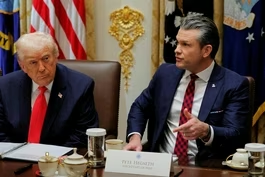
Hegseth on defense after Signalgate inspector general report
Video has Closed Captions
Clip: 12/5/2025 | 11m | Hegseth on defense after Signalgate inspector general report (11m)
U.S. boat strikes and war crimes questions
Video has Closed Captions
Clip: 12/5/2025 | 9m 44s | U.S. boat strikes and war crimes questions (9m 44s)
Providing Support for PBS.org
Learn Moreabout PBS online sponsorship
- News and Public Affairs

Top journalists deliver compelling original analysis of the hour's headlines.

- News and Public Affairs

FRONTLINE is investigative journalism that questions, explains and changes our world.








Support for PBS provided by:
Major funding for “Washington Week with The Atlantic” is provided by Consumer Cellular, Otsuka, Kaiser Permanente, the Yuen Foundation, and the Corporation for Public Broadcasting.