
Washington Week with The Atlantic full episode, 2/6/26
2/6/2026 | 26m 46sVideo has Closed Captions
Washington Week with The Atlantic full episode, 2/6/26
President Trump set off alarm bells this week by calling for Republicans to “nationalize” the upcoming elections. This comes amid questions about Director of National Intelligence Tulsi Gabbard’s role in election security. Join moderator Jeffrey Goldberg, Jonathan Lemire and Michael Schere of The Atlantic, Jonathan Karl of ABC News and Liz Landers of PBS News to discuss this and more.
Problems playing video? | Closed Captioning Feedback
Problems playing video? | Closed Captioning Feedback
Major funding for “Washington Week with The Atlantic” is provided by Consumer Cellular, Otsuka, Kaiser Permanente, the Yuen Foundation, and the Corporation for Public Broadcasting.
Washington Week with The Atlantic full episode, 2/6/26
2/6/2026 | 26m 46sVideo has Closed Captions
President Trump set off alarm bells this week by calling for Republicans to “nationalize” the upcoming elections. This comes amid questions about Director of National Intelligence Tulsi Gabbard’s role in election security. Join moderator Jeffrey Goldberg, Jonathan Lemire and Michael Schere of The Atlantic, Jonathan Karl of ABC News and Liz Landers of PBS News to discuss this and more.
Problems playing video? | Closed Captioning Feedback
How to Watch Washington Week with The Atlantic
Washington Week with The Atlantic is available to stream on pbs.org and the free PBS App, available on iPhone, Apple TV, Android TV, Android smartphones, Amazon Fire TV, Amazon Fire Tablet, Roku, Samsung Smart TV, and Vizio.
Buy Now
10 big stories Washington Week covered
Washington Week came on the air February 23, 1967. In the 50 years that followed, we covered a lot of history-making events. Read up on 10 of the biggest stories Washington Week covered in its first 50 years.Providing Support for PBS.org
Learn Moreabout PBS online sponsorshipSometimes it's difficult to tell if President Trump is just idly musing or giving us an indication that he's about to do something dramatic and unprecedented.
This week he set off alarm bells by calling for Republicans to nationalize the upcoming elections.
But as all Americans know or should know, the Constitution mandates that states run elections, not the federal government.
What did Trump's thoughts mean for the 2026 midterms?
We'll talk about this next.
This is Washington Week with the Atlantic.
Corporate funding provided by Consumer Cellular Additional funding is provided by Ku and Patricia Ewens for the Ewan Foundation.
committed to bridging cultural differences in our communities.
Sandra and Karl Delay Magnusson.
Rose Herschel and Andy Shreeves, Robert and Susan Rosenbaum.
Charles Hammoway through the Charles Hammoee Fund.
Steve and Marilyn Kerman.
Leonard and Norma chlorifying, and by contributions to your PBS station from viewers like you.
Thank you Once again from the David M. Rubenstein studio at WETA in Washington, editor in chief of The Atlantic and Moderator, Jeffrey Goldberg.
Good evening and welcome to Washington Week.
President Trump's obsession with elections, elections he's won, an election he lost, but claimed to have won elections he's afraid Republicans may lose is well documented.
There's a great deal of worry among election officials across the country that Trump will use whatever tools he has at his disposal, including most alarmingly, America's intelligence services to create doubt and confusion around the upcoming midterms.
Joining me tonight to discuss this and more Jonathan Carl, the chief Washington correspondent at ABC News and author of Retribution Donald Trump and the Campaign That Changed America.
Liz Landers is the White House correspondent for PBS Newshour.
Jonathan Lemire is a staff writer at The Atlantic and a co-host of Morning Joe on MS Now.
And Michael Shear is a staff writer and a White House correspondent at The Atlantic.
Thank you all for joining me.
Um, let's talk about this word nationalize.
There's a lot of stuff to unpack here.
What John, what does it mean to nationalize an election.
Well, I, I think for Trump it means to go in there and run the elections in states and localities that he's lost.
I mean, there isn't a, there isn't a great grand strategy here, but he's talking about some sense of a federal takeover of the way the elections are run.
Again, primarily exclusively focusing on places that he lost in 2020, right?
Let's, let's listen to what Trump told former Deputy Director of the FBI and current podcast er Dan Bongino, this week about, about this issue.
The Republicans should say, we want to take over, we should take over the voting, the voting and at least many 15 places, the Republicans or the nationalize the voting and we have states that are so crooked and they're counting votes.
We have states that I won that show I didn't win.
So here's a trivia question for all you political nerds.
What does Article 1 Section 4, Clause 1 of the Constitution say about this issue, please feel free to hit your buzzer at any time.
Michael, yes, it says states run elections.
Ah, interesting.
So and you know, President Trump came in, he issued a bunch of executive orders.
He tried to get rid of male voting.
He tried to change voting machine technology.
He tried to impose voter ID Almost all of that has been thrown out by the courts.
There's some still pending, but it's not going anywhere.
The course I can read the Constitution even if the president can't.
He can't get very far there.
Now what, what we've seen in the last couple of weeks though is something else.
He is using the full powers of the federal government, the FBI, the Office of the Director of National Intelligence, um, and, and other people in the Justice Department to suck up information to try and confirm the debunked theories he has about the 2020 election, 2022 election in the hopes that he might find a spark in all the smoke that's been created by his allies and that's a separate program that's been going forward.
John, I don't want to get all schoolhouse rock here, except that I actually do.
But why, why is it that the state, why isn't the founders, the framers of the Constitution, thought it was important to devolve election supervision to to local authority.
Well, in part to prevent exactly this from someone from a president or some sort of ruler to try to rig the system.
The authorities should be in the states.
That's that the United States of America, it's right at the beginning of a set like that.
And I think there's other interviews where the president has given about this where he's he's highlighted Philadelphia, Detroit, Atlanta.
What are those?
Those are big blue cities with frankly, majority minority cities, cities that he lost, and he knows where Democrats will do well again.
And Tulsi Gabbard heads there as you know as DNI, suggesting that some sort of foreign interference in American elections.
She made a separate trip to Puerto Rico.
Her team did, looking for it there as well.
And this is President Trump not just trying to relitigate 2 020 but Democrats are afraid this is about 2026, 2028, sowing confusion with the voter rolls, and while also perhaps putting even ICE agents on the streets.
I want, I want to come back to the, the extraordinary image of a director of national intelligence being involved in a in a law enforcement activity in Georgia and also Puerto Rico.
Obviously I want to come back to that in a minute, but I want to stay on this question of how it would even work in Trump's conception.
What, what would it would literally mean federal officials moving into local election boards and supplanting those people like, like Liz, where, where, what would he do in order to create this, uh, what he would think of as a fair election, meaning one that he would be guaranteed a winning.
Well, the White House was asked about this several times this week, and Caroline Levitt said that what the president actually meant was that he was supporting the Save Act, which is now a bill that may get a vote in Congress soon, and this is something that the Republicans are pushing for, and it has some pretty major changes to voting in this country, including voter ID would be required.
There's some changes to some of the other parts of what makes every state vote differently across the country, but the president himself, though, continued to double down on his own statement about nationalizing the election even after she said that's not really what he meant.
He said in the Oval Office later on this week after the Bongino interview, he said a state is an agent for the federal government in elections.
I don't know why the federal government doesn't do them anyways, so say that again.
A state is an agent of the state is an agent for the federal government in elections.
So I think that he does want to see, you know, who never thought that James Mattis.
or Hamilton or really anybody, yeah, I mean, look, the Constitution does say that Congress couldn't have a role.
Uh, what the person that doesn't have a role is the chief executive, is the right, right, right.
The last person to have a role, the last entity that would have a legitimate role is the Act requires rather onerously proof of of not just a photo ID proof of citizenship, and you must do every time you interact with the uh with your registration when you're changing your address, when you're moving any of that stuff, um, but, but, but look, what he wants is he wants to do away with mail-in voting, and he wants Republicans to be uh basically in charge of administering elections, not the federal government.
He wants Republicans to be in charge, so he's actually in his statements he's been using two different.
He's saying I want Republicans in charge and I want nationalized and in his mind they're interchanging they're they're interchangeable.
Liz, I want to just um uh play an interesting exchange that you had with Caroline Levitt, the White House spokes wo man the other day on election questions.
Let's listen to this.
Steve Bannon recently said, quote, We're going to have ice surround the poles come November.
Is that something that the president is considering.
That's not something I've ever heard the president consider.
No guarantee to the American public that ICE will not be around polling locations or voting locations in November.
I can't guarantee that an ICE agent won't be around a polling location in November.
I mean, that's frankly a very silly hypothetical question, but what I can tell you is I haven't heard the president discuss any formal plans to put ice outside of polling locations.
It's a disingenuous question.
Silly and disingenuous.
I think we would agree that it's a pretty good question.
What, what's the, what's the, what was your reaction to that, to that answer.
It didn't make it sound like ICE is not going to be deployed, right?
I think that that's the takeaway there.
Look, it's not legal to have federal law enforcement agents outside of polling locations.
We have laws and states have individual laws about this as well, how far you can be from a polling and voting location, but we've seen that this administration over and over has tested the bounds of the law on immigration, on a number of issues.
So I asked her this because Steve Bannon is an ally of the president, a former adviser to him.
He has a very large microphone and and for him to be talking about this and sort of putting this into the ether.
I thought it was important to sort of get it on the record with the White House whether or not they're talking about this.
Can I go ahead.
But look, there's a context here which is the Republicans fear major losses coming in the midterm elections.
They've had a series of setbacks.
You had the November losses in, in New Jersey and in Virginia.
You had the uh the loss in Miami.
Uh, you also had just over the weekend, a loss in a state race, statehouse race in Texas where a district that had gone overwhelmingly for Trump was suddenly won by Democrats.
The fear is that we're looking at a at a real blue wave for these midterm elections.
That's the context here.
I think that part of this is trying to intimidate Democratic voters and part of it is laying the groundwork to challenge the election results from midterms.
Go ahead.
There's also real tension over this in the White House.
I mean, I was told this week that after the president came out with those statements, his senior advisers were saying no, nationalizing is not it.
These are people who are working on the investigation in Fulton, you know, working on the other, the the Georgia, the Georgia case who support what Tulsi Gabbards are doing.
But, but nationalizing is not the route to do this.
I think they're going to let him continue to do what he has done now for, you know, 10 years, which is to raise doubts about anything that doesn't go his way and claim fraud and mistakes, but they also know his own advisers know that you know, by if you remember back in, in, in 2020, there were two Senate seats in Georgia that were lost in a runoff because the president said don't trust this vote.
I won in Georgia.
The, the voting lies, and what that meant was Democrats turned out and voted in the runoff, and Republicans did not turn out and vote in the.
So there are also Republican consultants who are very concerned about this test, right?
Let me ask all of you who cover the the White House.
I'm interested in the way Bannon is used as a, well, is he used to float test balloons, or is it less coordinated than that?
Does he, does he put that out in coordination with the president, or does it just happen organically.
I think there's communication, but I think there is a set of uh troublemakers that the president likes to talk to.
I mean, we, we know a lot more names than just Bannon, who mean like the Laura Laurer type, yes, and other people activists in the party, people who, you know, conspiracists around election stuff he talks to, but they are not part of the the internal government process, but there are times where the president will reach out to Steve Bannon and take his, take his advice on things, and Ben, and sometimes the coordination often it's just banning getting going first, but sometimes the president gets there because Bannon has has sort of sort of planted the seeds and and and on this one, it's not just ICE agents.
He's even suggesting the Insurrection Act should be called in November 1st airborne.
He wants to send the 101st Airborne to polling places.
You said that this week.
That's your question next week, I guess, but I have some of the, the, the craziest stuff on this is on Donald Trump's Truth social feed.
It's not even from Steve Bannon or any of the, of the conspiracy theorists.
I mean, as he is sending Tulsi Gabbard, his director of National Intelligence to Fulton County.
We also see on his true social feed, he is posting one of the wackiest conspiracy theories that I ever encountered about 2020, which is that Italian spy satellites were used to flip to hack into voting machines to flip votes, and it even added new elements to this it's an old theory.
It goes back, I wrote about it like 5 years ago, uh, but, but the new elements of these uh uh of the theory is that the Chinese funded it.
The CIA computer big central computer was about it, and the FBI covered it up.
This is on the President of the United States, social media platform.
The vice presidents of Italy right now getting to the bottom of it.
At the very time, how many satellites does Italy have anyway?
I mean, we spent a lot of time talking about Italian satellitenologies.
What I, what I learned in reporting on the last time we dealt with his 2020 stuff, is that he asked his DNI at the time, who was John Radcliffe, the current CIA director, to use the power of the DNI to look into this stuff, and Ratcliffe had to quietly explain to him that, you know, we don't do domestic law.
Well, let's stay on that because it in the sort of litany of extraordinary events, the, the, the nerd in me thinks that one of the, one of the most unusual things I've seen in the last year is the head of national intelligence, going to an FBI raid of a local election board.
I mean, not to get all schoolhouse Rocket gear, but why explain why that is so odd.
I mean, it's, that's not her job.
I mean, it's that she is not involved with election security.
She's and the story has shifted so many times as to why she was there, who sent her there?
Was it the Attorney General?
Was it the president, you know, Gabbard in a letter to Congress, says that she went there on Trump's behalf in his behest, you know, but there are, I think it's 5 or 6 different times that we've gotten different accounts as to why she was there, pursuing these unfounded conspiracy theories about foreign.
Can you think of another time in American history where it openly and in te ll ig ence service of the United States focused on foreign threats has gotten this deeply involved in American election issues.
It's not supposed to happen.
It's not supposed to be using the powers of the intelligence agency to effectively spy on Americans.
That's not what it's.
She put the president on the phone with the FBI agents to congratulate them for what the work they were doing, and I would just add to that I spoke with an election attorney this week who was making the point that because the president has now been so involved with what happened in Fulton County because he was on the phone with those FBI agents because he apparently sent her down there according to what she sent in a letter to Congress that this is now completely bungled whatever investigation and whatever the DOJ and FBI tries to present going I mean there's nothing to really investigate.
This has been so thoroughly investigated.
What we and you know, I mean this also gets to the point of who is in the White House now.
Who is in the president's cabinet because Donald Trump wanted those ballots to be seized in 2020.
He wanted Bill Barr to activate the Department of Justice to do it, the former Attorney General.
And then when Barr left, he wanted Barr's replacement.
Acting Attorney General Jeffrey Rosen to do it.
When Rosen wouldn't do it, he threatened to fire him and install somebody who would do it, a guy named Jeffrey Clark.
When the president was about to do that, the entire civilian leadership of the, you know, political leadership of the Department of Justice threatened to resign en masse, and it didn't happen.
Now he has an attorney general that will do what he wants, whatever he wants, and he has a director of National Intelligence who will also do whatever he asks.
Let me, um, let me note that, uh, the president seems to be, this is my impression, talking more and more about 2020 and more and more.
Is this a sign that he is actually worried about what's coming down the pike on the on the in the midterms.
Well, he's almost, he's basically said that presidents almost always lose, and one of the things the White House's preparing the ground for one of the things his advisers have been telling him is don't be so fatalistic about this.
They want him out on the road.
They're going to get him increasingly out on the road as the year goes on.
They've got to excite people for this election, and the truth is he's not in that mind space right now.
He sees what most political observers see that this is not the polling does not suggest there's much hope for Republican Congress.
I would just add my observation has been that the president talks a lot about the election and the rigged election of 2020.
His false claims about that.
What I think is new that we're seeing more recently is that he's talking increasingly about how he's going to change the midterm elections and how he's using the government to investigate things in ways that we've never seen before.
So it's more the forward looking part of this that I think is different.
That's interesting.
I mean, at the National Prayer Breakfast this week.
He, he spoke about this in a way that one usually doesn't hear at the National Prayer Breakfast.
Let's go, let's just watch 11 minute of that.
They rigged the 2nd election.
I had to win it.
Had to win it.
I needed it for my own ego.
I would have had a bad ego for the rest of my life.
Now I really have a big ego, the beating, beating these lunatics was incredible, right?
What a great feeling winning every swing state, winning the popular vote.
I believe he's paraphrasing Saint Francis of Assisi here, by the way, it was such an odd location.
The reason that it struck me is because it's such an odd location to do that.
very honest riff in a kind of way, he's talking about his preoccupations, but you're saying that he's he using those moments to lay the groundwork for this belief that the Democrats will never let him win.
Is that the sort of thing that's going on?
He's also been talking about the election and and the fact that he thinks that he won places like Minnesota, 3 times.
This is something that he's also been saying recently when people are talking about the ice operations there and stuff, so he is really, really fixated on this.
I think more now that we're in the new year, now that the midterms are looming now that he's talking about possible impeachment, which I think probably will happen if Democrats retake the House, so I, it's all of those.
John, you wrote this week, you talked about the president not helping his own midterm cause by doubling down on the wrong things.
What did you mean?
Yeah, well, I mean, because of that race in Texas in particular, a thunderclap for Republicans.
This was a seat that the Democrats had not won since 1978.
It was a 31 point swing since November 2024 when Trump was elected again.
And, and they're telling Republicans are saying quietly and increasingly publicly focus on the economy, focus on how you're trying to make people's lives better.
And instead, the president is, he's doubling down on these election fraud conspiracies.
He's doubling down on gunboat diplomacy.
He's doubling down on leaving his lasting imprint on Washington, whether it's the White House ballroom or we've seen the last week or so with the Kennedy Center, and they're and they're saying to him, this isn't how you win elections or help us.
We'll stay on that for a minute because I mean let's talk about the Kennedy Center, Penn Station in in New York and Dulles International Airport, which I'll have a couple of things now in common.
They're very drafty and impersonal, and Donald Trump wants to have his name on all of them.
Is that not working for the base anymore, this desire to rename everything.
He's telling on himself that he clearly doesn't ride the train very much because you wouldn't want your name on Penn Station in New York City, the Moynihan Station Moynihan.
I actually think since they put it in the post office, the part of Penn Station part is still very Dulles Airport, you're not going to get me to defend.
No, no one here would.
No, I don't think that there are too many Republican voters who were eagerly put President Trump back in office, who said among their top three issues were, I hope he gets his name on more things, right?
I guess what I'm getting at is you combine that psychologically with what he said at the prayer breakfast.
My ego needed, it seems that we're we're moving into a phase where he's even more obsessed with building things to put his name on and just sort of grandiosity, maybe I'm he's always wanted to put his name on, on, on things, but there's something much more ramped up this time, and that is, he's thinking about his legacy.
You see it in what's happening at the White House, not just the reconstruction he's doing, but presidential portraits everywhere that you just didn't see last time.
There were a couple, his first term, but he's really thinking about his place in history, and that's why I think that's part of what's motivating him to make really big dramatic changes that will outlast him.
Um, but this Penn Station and Dulles thing goes beyond just putting his name on something.
He's holding or trying to hold in a judge just now, at least temporarily blocked to this.
He's trying to put $16 billion on hold that's been appropriated by Congress, signed into law for this big tunnel project and saying directly to Schumer, I'm told in the Oval Office directly to Schumer.
Well, hey, you know you could name Penn Station and Dulles already backfired once.
It's already backfired once.
It was a gift to the Democratic gubernatorial candidate in New Jersey when he killed the tunnel the first time.
That was a closer race, and then it swung her way, right?
I want to in a couple of minutes that we have left, I want to switch subjects and go to the subject of The Washington Post.
We have a lot of people who come on our show from The Washington Post with a lot of people at the Atlantic who once worked at The Washington Post, including Michael.
Michael, uh, I know it's hard not to talk about the 300 people who just lost their job, but I want to, I want to lift up and have you talk about, about it maybe at a, at a, at a sort of uh um moral level, what does it mean for journalism and democracy when this happens to one of the three major newspapers of the United States.
I think it's a serious blow, and it's a serious blow because there was so much optimism in that paper, you know, when, when the new owner Jeff Bezos took over.
It was 2013.
President Obama just been elected.
He embraced this idea of democracy dies in darkness.
That was a term that like even reporters at the Post were like, well that's a little aggressive, you know that that's going to be our motto.
He leaned fully in and as soon as the winds changed, as soon as, you know, the president switched voters were looking like they're going to re-elect President Trump.
He entirely flipped, and the decisions that have been made since 2024 have repeatedly hurt the place, not made it stronger, and I think history will almost certainly show that what happened this week is going to make it weaker still.
Was this an extinction level event or an extinction level threat for a newspaper?
I think it's extinction level threat for Jeff Bezos' Washington Post.
Yes, I don't think there is a path for that to recover, and I think it's just a matter of time before he decides to move on from it and sell and allow somebody else to try and rebuild it.
John, last question to you on this.
A lot of Republicans are saying, oh well, the Washington Post is having these problems because it was too liberal, um, but they think the same thing about the New York Times, which is flourishing newspaper.
How do you understand this ideologically, or do you?
I mean, look, the Washington Post thrived under in Trump's first term, The Washington Post really started to spiral after a series of editorial decisions actually in the direction of the right when they refuse to do it when Bezos didn't want to do an editorial endorsing Kamala Harris that had already been written, wanted to make changes in the editorial page, the slant of the editorial page, and they lost hundreds, 250,000 subscribers.
That's a big blow, right?
Well, I mean, it, it is, and I don't want to dismiss this.
It is a tremendous blow to a lot of people in our industry.
They're very talented people.
They will be fine, but, but we have to be very vigilant about independent journalism in this country.
We really, really do, um.
I'm sorry to say that's all the time we have for now.
I want to thank our guests for joining me and I want to thank you at home for watching us.
You can find Jonathan Lemierre's article on President Trump's priorities at theatlantic.com.
I'm Jeffrey Goldberg.
Good night from Washington.
Corporate funding for Washington Week with the Atlantic is provided by.
in 1995, 2 friends set out to make wireless coverage accessible to all.
with no long term contracts, nationwide coverage and 100% US-based customer support.
Consumer Cellular, Freedom calls.
Additional funding is provided by Ku and Patricia Ewens for the Ewan Foundation, committed to bridging cultural differences in our communities.
Sandra and Karl Delay Magnusson.
Rose Herschel, and Andy Shreeves, Robert and Susan Rosenbaum.
Charles Hammoway through the Charles Hammoee Fund.
Steve and Marilyn Kerman.
Leonard and Norma chlorifying.
and by contributions to your PBS station from viewers like you.
Thank you.
You're watching PBS
Tulsi Gabbard’s role in election security investigations
Video has Closed Captions
Tulsi Gabbard’s role in election security investigations (11m 12s)
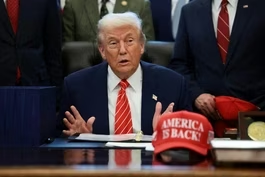
What Trump’s call to ‘nationalize’ elections means
Video has Closed Captions
What Trump’s call to ‘nationalize’ elections means for the midterms (12m 33s)
Providing Support for PBS.org
Learn Moreabout PBS online sponsorship
- News and Public Affairs

Top journalists deliver compelling original analysis of the hour's headlines.

- News and Public Affairs

FRONTLINE is investigative journalism that questions, explains and changes our world.












Support for PBS provided by:
Major funding for “Washington Week with The Atlantic” is provided by Consumer Cellular, Otsuka, Kaiser Permanente, the Yuen Foundation, and the Corporation for Public Broadcasting.